
Summarize this with
 ChatGPT
 Claude
 Gemini
 Perplexity
Markus put it perfectly on our podcast: "You cannot just delete all comments. You also need those signals for the algorithm, like 'Okay, many people are commenting.' You can tell that the CPC goes down when an ad polarizes." He was right. And still most brands reflexively click "Hide comment" on every negative comment.
According to an analysis of 118.4 million comments, every sixth comment (16.7%) is hidden by moderation (Respondology, 2025). Of those, only 57.5% are actually spam. The rest? Real opinions, questions, buying signals, which you take away from the algorithm and your potential customers.
Guide: Automate comment moderation
TL;DR: Hiding all negative comments across the board costs you engagement signals that Meta rewards with lower CPMs. 42.5% of hidden comments are not spam, they are real interactions (Respondology, 2025). Selective auto-hide with AI-powered tagging separates spam from criticism, and protects your ROAS.
What really happens when you hide a comment?
Since February 2025, Meta has tracked comments, likes, and shares as conversion-driving actions in the "Engage-Through Attribution" model (Search Engine Land, 2025). Hiding a comment means: you remove a signal that Meta actively uses for ad optimization. The platform registers less engagement, and your CPM rises.
Facebook: hide vs. delete a comment
On Facebook you have three options: hide the comment, delete it, or block the author. When you hide it, the comment remains visible to the author and their friends, everyone else no longer sees it. For the algorithm the comment still counts as an interaction. When you delete it, it disappears completely, also as an algorithm signal.
At first that sounds straightforward: hiding is better than deleting. But there is a catch. If you systematically hide 30% of your comments, you reduce the visible discussion for everyone reading along. Fewer visible comments = less social proof = fewer replies to the remaining comments. That chain reaction harms your post.
Instagram: Deleting comments follows different rules
Instagram does not offer a "hide" in the Facebook sense. You can delete comments or restrict users. Deleting removes the comment completely, including the engagement signal. Since replies to Instagram comments boost engagement by +21% (Buffer, 2026), every deleted comment is a missed chance for further interaction.
If you automatically delete comments on Instagram, you risk more than just a missing signal. The entire comment chain, including all replies beneath it, disappears as well. That is especially painful when other users have already replied to a critical comment.
TikTok: The spam hotbed
TikTok stands out: 44% of all comments there are hidden by moderation (Respondology, 2025). That is due to the massive spam problem. At the same time, TikTok is the platform where comments contribute most strongly to virality. Whoever deletes too aggressively here interrupts the algorithm loop that drives your reach.
Handling negative comments on ads correctly
When does auto-hide harm the algorithm and your ROAS?
Higher engagement improves the Meta Relevance Score, and lowers your CPM (Meta Ad Relevance Diagnostics). That is no secret. But we ignored it anyway. Thomas once said it outright: "Back then we also tried to just hide everything. But that did not improve performance, quite the opposite."
The engagement signal problem
Meta's algorithm rates ads by interaction quality. Comments, even critical ones, are the strongest signals here. Replies to comments boost engagement on Facebook by +9.5% and on Instagram by +21% (Buffer, 2026). Whoever hides a comment instead of replying to it throws away that signal twice over: no reply engagement, no visible thread.
Think about this: Why does CPC go down when an ad polarizes? Because people comment. Because they reply. Because they argue. The algorithm reads that as "relevant content". And it rewards that with reach. Your auto-hide filter does exactly the opposite, it signals: "Nothing interesting is happening here."
The Friday night disaster: a real-world example
I remember a top-performing ad. Paused on Friday, checked it on Monday: "Don't buy this, it's fake!" with 50 likes. The ROAS tanked. But not because the comment existed. Because it went unanswered. All weekend long potential buyers read that comment and found no counterargument.
The solution would not have been to hide the comment. The solution would have been to reply to it. 45% of consumers are more likely to visit a business when it responds to negative reviews (ReviewTrackers, 2024). That applies to Google Reviews, and just as much to ad comments.
The ROAS proof: Zauberfein A/B test
In the Zauberfein A/B test we measured it under controlled conditions. Same ad, same budget. Managed vs unmanaged. Not "hide everything" vs "show everything", but strategically moderated vs completely ignored. Result: +48% ROAS and +54% conversion rate for the managed variant (internal case study, 2025).
Daniel Bidmon said about it: "That's also a bad sign for your performance in the end," referring to deleting all comments. He's right. Every deleted or hidden comment that wasn't spam is a lost engagement signal.
Optimize social proof in ads: how comments boost your ROAS
When is hiding comments the right choice? The spam question
57.5% of all hidden comments are actually spam (Respondology, 2025). Hiding spam comments is not only right, it is necessary. AI-generated spam rose 25% year over year (Respondology, 2025). Your posts drown in bot junk if you do not filter automatically.
Spam vs. criticism: the 42.5 percent gap
This is where it gets interesting. Almost half (42.5%) of hidden comments are not spam. They are real criticism, questions, or opinions. If your auto-hide filter cannot distinguish between "This product is garbage" and "💰 Click here for 500€", you are deleting engagement you need.
Nearly 30% of all comments under Meta Ads are hidden due to spam or toxicity (Respondology, 2025). But how many of those were really toxic, and how many were simply inconvenient? A comment like "I've had better experiences with other products" is not spam. It is an objection you can answer professionally.
Why perfect comment sections make people suspicious
Brands with a 4.0-4.5 star average get more clicks than those with 5.0 stars (Northwestern/PowerReviews, 2023). Perfection is suspicious. The same applies to your comment section. When an ad only has "Great product!" and "Super quality!" beneath it, everyone thinks of bought reviews.
73% of consumers buy from the competition when a brand does not respond (Sprout Social, 2025). But they also do not buy when the comment section looks suspiciously clean. The sweet spot: leave real criticism standing and answer it professionally. That builds trust, with readers and with the algorithm.
Delete, hide, or reply? The decision matrix
4% of all D2C comments contain concrete buying intent (Respondology, 2025). Hiding or deleting these "Marketing Qualified Comments" would be like deleting a warm lead from your CRM. The right action depends on the comment type, not on a blanket rule.
Scenario 1: Obvious spam
Action: Automatically hide. Bot comments, phishing links, fake giveaways, those need to go. Auto-Hide even helps the algorithm here, because spam engagement is not a real signal. Use rule-based filters or AI-powered tagging to automatically hide these comments.
Scenario 2: Insults or hate speech
Action: Hide and block the author. Comments that violate community guidelines should be hidden. This is not about the algorithm, it is about the safety of your community. The author can still see their comment. The "Block" option prevents future comments on your profile.
Scenario 3: Constructive criticism
Action: Reply. "Poor value for money", "Delivery took three weeks", "Quality does not match the advertising". These are not attacks. These are objections that hundreds of silent readers also have. Whoever responds professionally and honestly here not only converts the commenter, but everyone reading along.
Scenario 4: Buying signals and questions
Action: Reply quickly. "Does this also come in blue?", "Do you ship to Austria?", "Has anyone tried this yet?", those are leads. Every minute without a reply lowers the purchase probability. Replies to comments boost engagement on Facebook by +9.5% (Buffer, 2026). That strengthens the algorithm at the same time.
Community management is sales, not support
How does selective auto-hide with AI-powered tagging solve the problem?
AI-generated spam has risen 25% year over year (Respondology, 2025). Manual moderation no longer scales. But blanket auto-hide harms the algorithm. The solution lies in between: tag automatically, hide selectively. Only spam and hate speech go out, leave everything else standing and reply.
How AI-powered tagging works
Instead of treating every comment the same, the AI analyzes the content and automatically assigns tags: Spam, Complaint, Buying Intent, Question, Praise. Only then does the automation kick in. Comments tagged "Spam" are automatically hidden. Comments tagged "Complaint" or "Buying Intent" remain visible and trigger a reply recommendation.
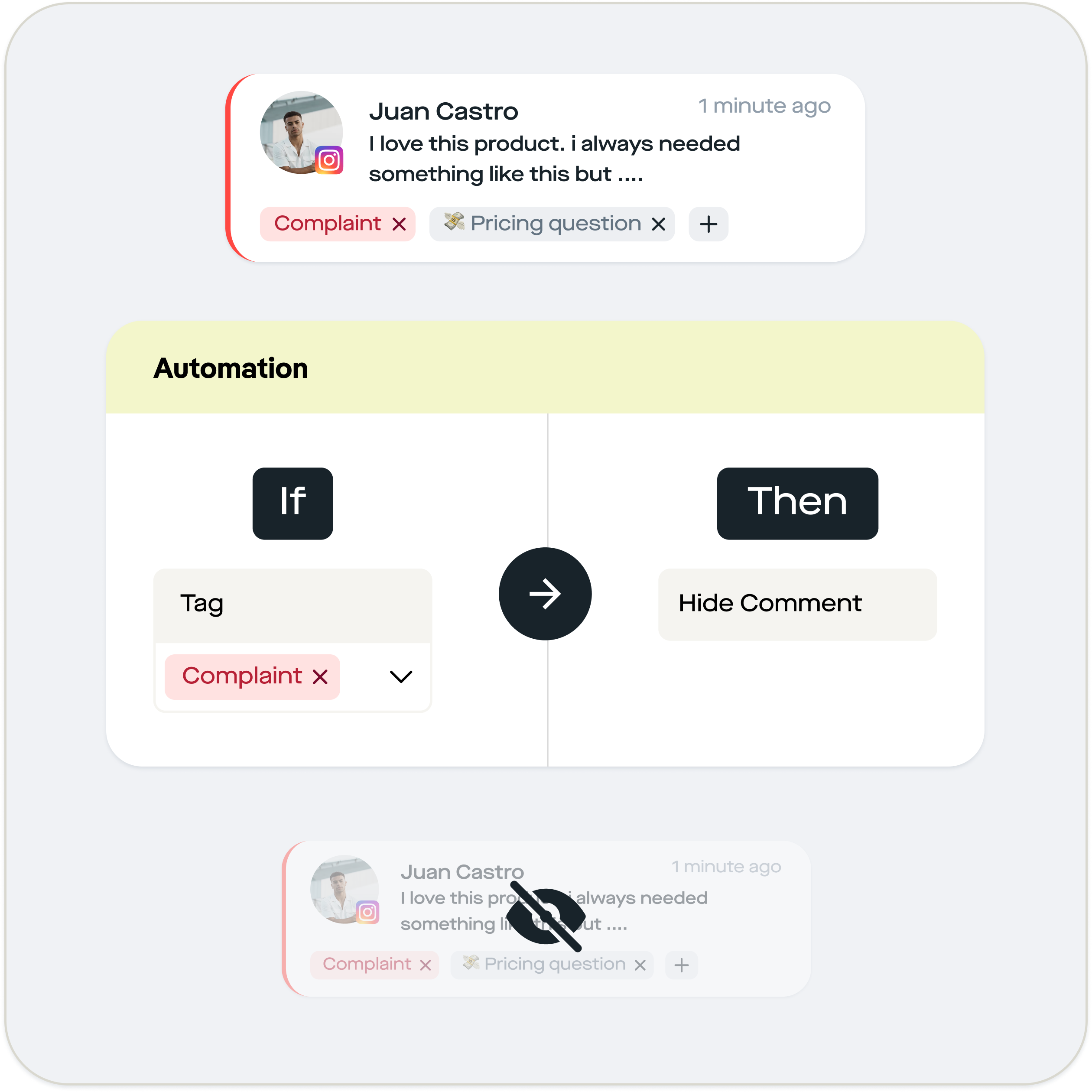
The difference from blanket keyword filters
Traditional keyword filters hide any comment that contains "bad", "expensive", or "fake". The problem: "Is the product really as bad as some say? I'm interested!" is a buying signal, not spam. Keyword filters do not recognize context. AI-powered tagging does.
This is clear in practice. Brands that switch from keyword filters to AI-powered tagging keep more genuine interactions visible. The algorithm receives stronger signals. The post gets more reach. And the comment section appears authentic, not sterilized.
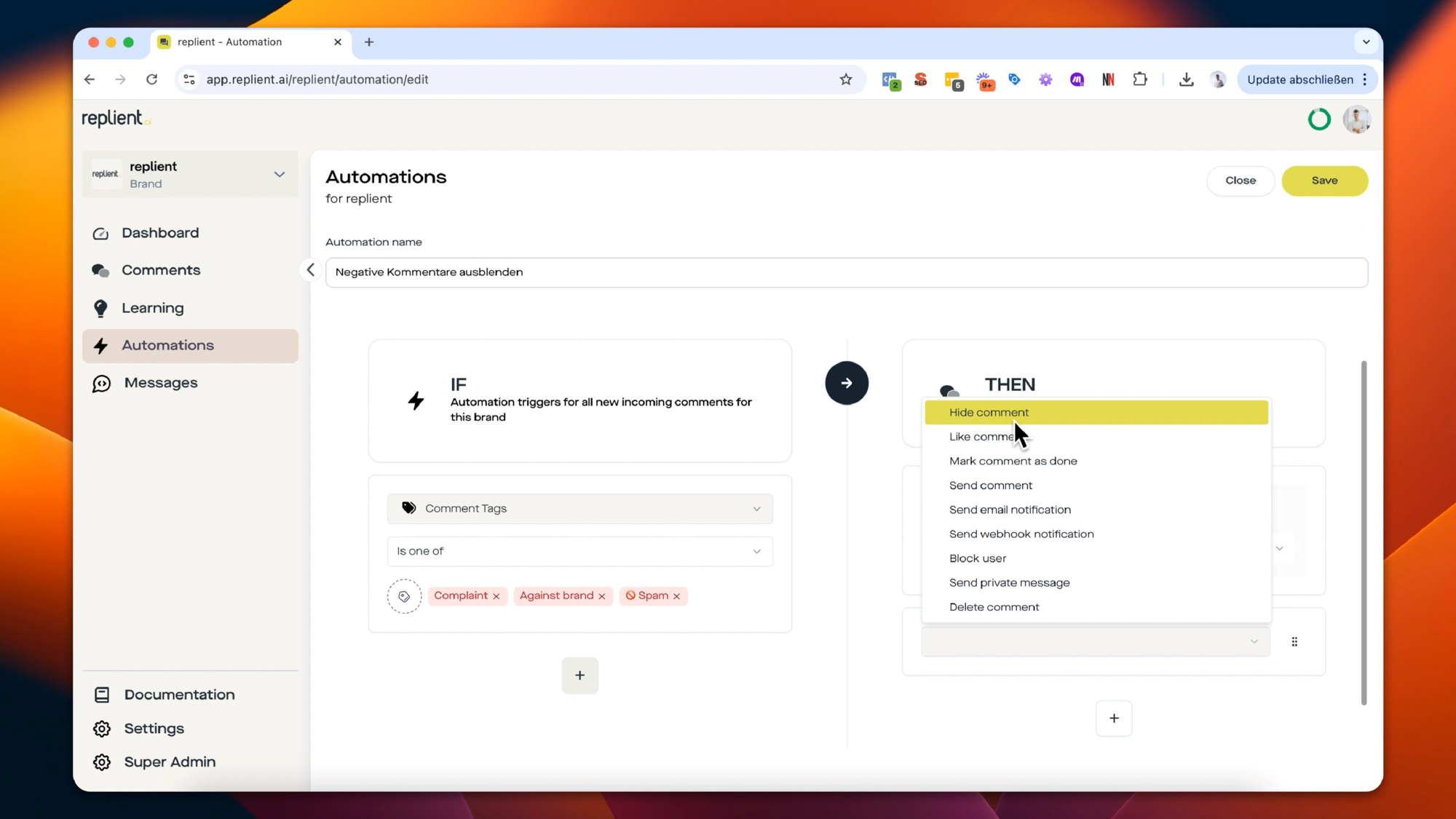
Use case: selectively hiding comments

Frequently asked questions about automatically hiding comments
Does a hidden comment still count for the Facebook algorithm?
Yes, partially. A hidden comment remains in Meta's data as an interaction. But the visible social proof disappears for everyone except the author and their friends. That means: the engagement signal stays, but the chain reaction (replies, likes on the comment) stops. Replies to comments boost engagement on Facebook by +9.5% (Buffer, 2026), and that potential is lost when you hide.
Should I automatically hide negative comments under ads?
No, not across the board. Only spam and hate speech deserve auto-hide. Factual criticism you should answer: 45% of consumers are more likely to visit a business when it responds to negative reviews (ReviewTrackers, 2024). In the Zauberfein A/B test, ROAS rose by +48% through active objection handling, not through hiding.
How to properly handle negative comments under ads
What is the difference between deleting a comment and hiding a comment on Facebook?
When you delete a comment it disappears completely, for everyone, including the algorithm signal. When you hide it, it stays visible to the author while everyone else cannot see it. The engagement signal is partially preserved for hidden comments. Deleting is the tougher option and should only be used for clear policy violations.
How many comments are hidden on average?
Every sixth comment (16.7%) is hidden by moderation, across 118.4 million analyzed comments (Respondology, 2025). On Meta Ads the rate is nearly 30%, on TikTok even 44%. Of those, 57.5% are spam, the rest are real comments lost to overly aggressive filter rules.
Can Auto-Hide improve my ROAS?
Selective auto-hide can improve your ROAS, if it only removes genuine spam. Hiding all negative comments across the board, on the other hand, harms performance. Higher engagement improves the Meta Relevance Score and lowers the CPM (Meta Ad Relevance Diagnostics). The key is: spam out, answer criticism, use buying signals.
The golden rule: hiding is no substitute for responding
Auto-hide has its place: spam, phishing, hate speech, those should be removed. But 42.5% of hidden comments are not spam. They are engagement signals your algorithm score needs. They are objections you can answer professionally. And 4% of them are even purchase signals, warm leads that you are taking away from the algorithm and your revenue.
The brands that understood this use selective auto-hide with AI-powered tagging. Spam is automatically hidden. Criticism is answered. Purchase signals are prioritized. The result: +48% ROAS, +54% conversion rate in a controlled A/B test. Not by hiding. By responding.
Start with selective auto-hide instead of blanket moderation. Try it free now, 14 days free.
About the author

Thomas Danninger
Co-Founder, replient.ai
Thomas ist Co-Founder von replient.ai und Experte für KI-gestütztes Social Media Kommentar-Management. Er schreibt über Automatisierung, Community Management und effiziente Kommentar-Moderation für wachsende Brands.