Summarize this with
 ChatGPT
 Claude
 Gemini
 Perplexity
Someone asks under your Reel: "Does this fit on a small balcony too?" You reply: "Yes, that's exactly what it's made for!" Done, ticked off, next comment. This is precisely where you throw away most of the social media engagement your post could ever get. Because with your reply, the conversation is over. And to the algorithm, a finished conversation is a post where nothing is happening anymore.
The numbers behind this are clear. Posts where the brand replies to comments get 21% more engagement on Instagram and 30% more on LinkedIn than posts without replies (Buffer, 2026, 52 million posts analyzed). And posts that ask a question in the caption get 36.7% more comments (Metricool, 2026). Combine the two, a reply that asks a question of its own, and you get a loop. For one of our customers, that loop took comments per day, and with them engagement per post, to 10x, with the same content output.
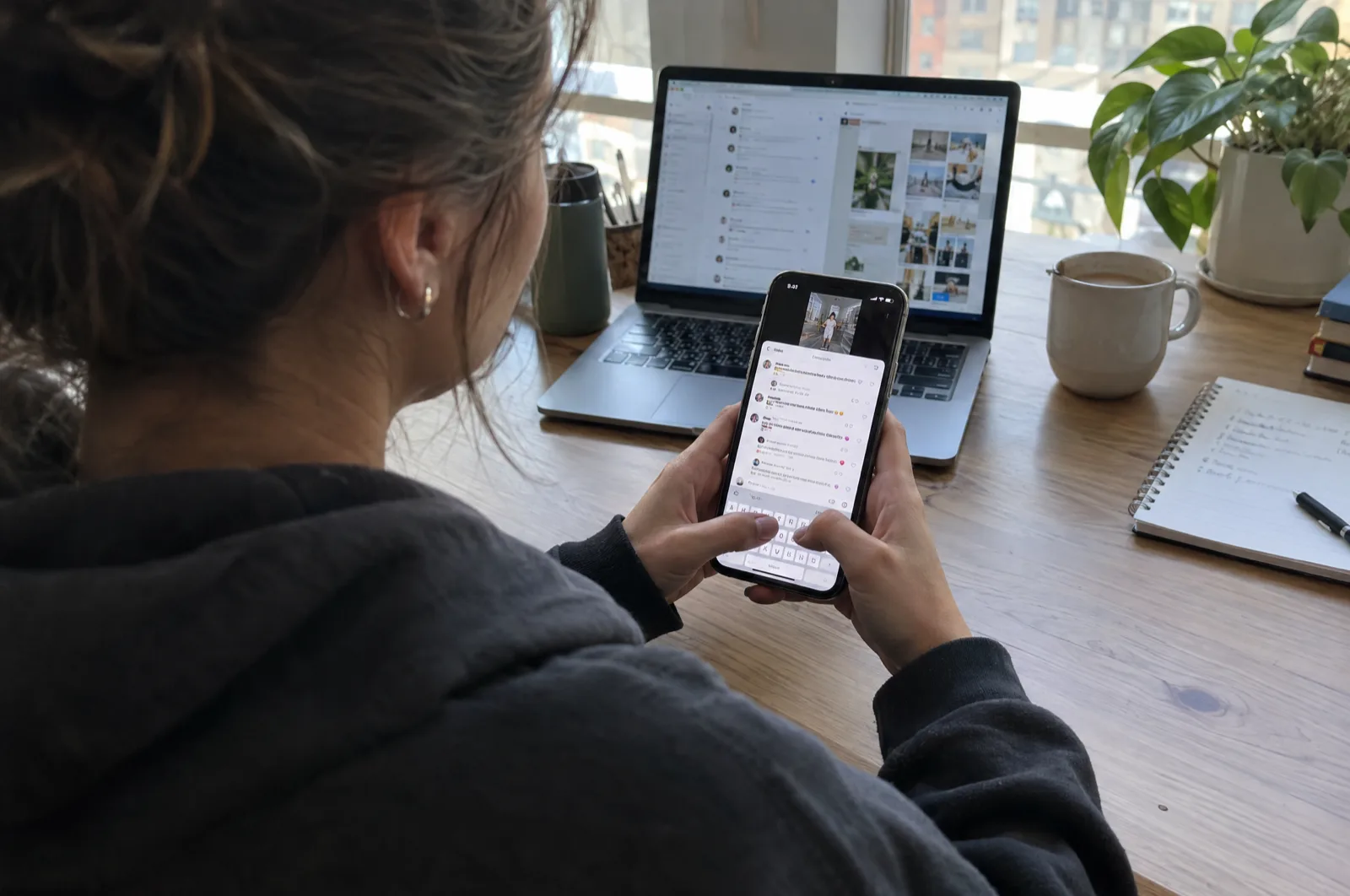
TL;DR: You don't increase social media engagement by posting more, you increase it with longer conversations under your posts. According to Buffer (2026), replying to comments brings 21% more engagement on Instagram, and questions bring 36.7% more comments (Metricool, 2026). If you end every reply with a fitting follow-up question, you keep the thread alive. One replient.ai customer went from 300 to 3,000 comments per day this way.
Why does most social media engagement end after the first reply?
Only 7% of the messages and comments brands receive every day get a reply at all (Sprout Social, 2026, 3 billion messages analyzed). And the few that do get a reply almost always get a closed one: Yes, No, Link in bio, Thanks for your feedback. The conversation is over before it even started.
The problem isn't laziness. It's the support mindset. A comment gets treated like a ticket: question in, answer out, status "resolved". We explained in detail why that's fundamentally wrong in Community management isn't support, it's sales. For engagement, though, there's a second effect on top: every closed reply takes away the platform's signal that something is happening under this post right now.
And the expectation on the other side has been there for a long time. 73% of consumers expect a reply within 24 hours, and 51% of those who comment publicly want to be addressed publicly first, not by DM (Sprout Social Index, 2025). So the comment thread is exactly where your audience wants to talk to you. The only question is whether you cut the conversation off after one round.
What really pushes the algorithm: likes or conversations?
Instagram says it officially: for every post, the feed algorithm predicts how likely you are to "spend a few seconds on a post, comment on it, like it, share it, and tap on the profile photo". Instagram measures a post's popularity by "how quickly people are liking, commenting, sharing and saving a post" (Instagram, Ranking explained). Comments and time spent are right at the top of the list of predicted interactions.
In January 2025, Adam Mosseri named the three most important signals for reach: "watch time, likes and sends" (Social Media Today, 2025). Comments aren't in his top three. So why are follow-up questions still so effective? Because an ongoing conversation produces exactly these signals. Anyone who replies to a follow-up question comes back to the post, sees the video again and spends time there. Watch time isn't only generated on the first scroll.
On the other platforms, the link is even more direct. TikTok explicitly lists the "comments you post" as an input for the For You feed and weights strong interest signals, such as watching a video all the way through, more heavily than weak ones (TikTok Newsroom). LinkedIn uses dwell time as a ranking signal and has found that members stay longer on posts they react to (LinkedIn Engineering). LinkedIn Editor-in-Chief Dan Roth describes the logic like this: "Our system is like, 'This is a conversation, and people want to be part of this conversation. Show this to more people.'" (Entrepreneur, 2023).
Buffer sums up the mechanism in three short sentences: "Replies create more comments. More comments send stronger quality signals. Those signals keep your post alive in the feed for longer." (Buffer Creator Growth Playbook, 2026). And the recommendation that follows right after: "Ask follow-up questions to keep conversations going."
The follow-up question effect: what happens when you ask back?
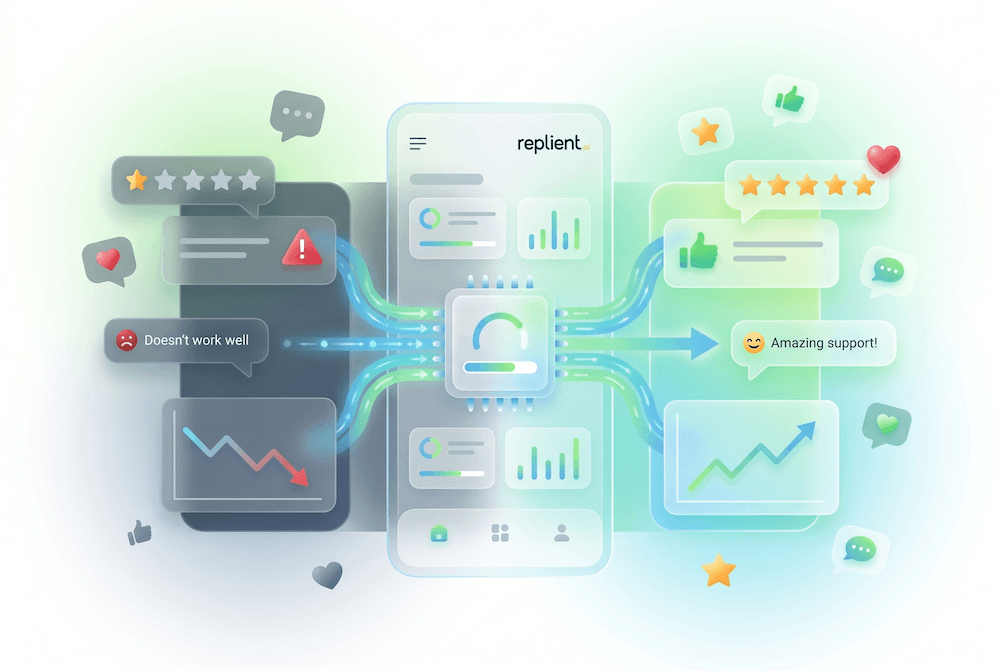
When a brand comment triggers a reply, engagement is 1.6x higher than for comments that get no reaction, according to Hootsuite Social Trends 2026 (Hootsuite, 2026). A follow-up question turns that single reaction into a chain. It sets off a very specific sequence in the person who commented, one you can picture as a small loop.
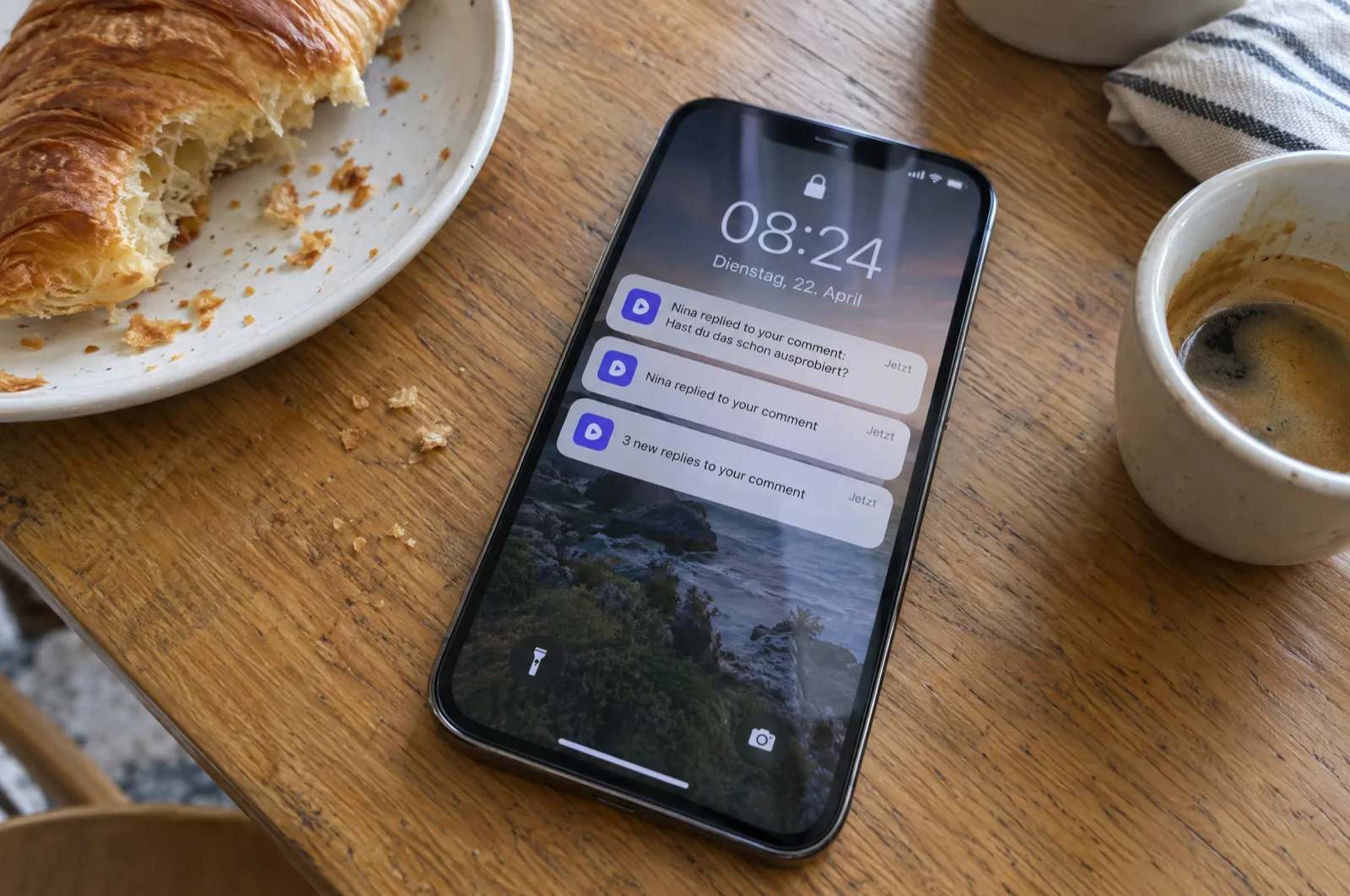
It runs in five steps, and each one is a signal:
- Push notification. "replied to your comment" is addressed to you personally, so it doesn't drown in the notification noise. An open question inside it raises the pressure to reply.
- Return to the post. The person taps the notification and lands back on your Reel or video. Second visit, second impression.
- Rewatch. The video keeps playing in the background while the comment section is open. Watch time and completion rate go up without you posting anything for it.
- Open the comments and reply. A new comment, a longer thread, more time on the post. On TikTok, a comment even counts as active input for that person's own For You feed.
- Next follow-up question. The AI, or you, replies with another fitting question, and the loop starts over. Two to three rounds turn one original comment into four to six more comments, plus the repeat visits to the post.
Our observation from customer data: The effect doesn't come from more people commenting. It comes from the same people commenting several times, coming back several times and staying longer. That's exactly what the engagement depth KPI measures, and almost nobody tracks it. The platform sees a post that's still generating conversations after 24 hours and keeps distributing it. That's the difference between "lots of comments" and "long conversations".
Case study: from 300 to 3,000 comments per day
A US health brand from our customer base started out at around 300 comments per day. Today it's about 3,000 per day, with the same content output and the same team (replient.ai customer data). For comparison: according to Socialinsider, the median is 20 comments per Instagram post and 50 per TikTok video, and falling (Socialinsider, 2026). The brand reversed that trend with exactly one setting.
The lever was the "Smart Questions" feature in replient.ai. Once it's switched on, every AI suggestion includes a fitting follow-up question. In the health space, a thread then looks like this: someone writes "I have that problem too." The reply: "A lot of people here do. What have you tried for it so far?" Reply: "Honestly, nothing yet." Next reply: "Then the routine from the video is a good starting point. Let us know how it's going after two weeks." One comment turns into a one-on-one conversation, in public, under the video.
My brother Markus described it on the EcomSecrets podcast like this: "Every video, including the ones they post organically, just gets so much more relevance on the platforms from the algorithm's point of view. They now have ten times the engagement, purely because of this tool. You don't have to convince people to opt in to an email list. You're simply chatting with them every ten minutes." What he didn't say: answering 3,000 comments a day by hand would have taken around 15 assistants at roughly 200 replies per person per day. That's why the account runs fully automated, with a random delay of one to ten minutes per reply so it doesn't look like a bot. We work out the volume at which this pays off in When is automation necessary?.
How do you write a follow-up question that increases social media engagement?
Comments with 50 to 99 characters get 151.6% more engagement than shorter or longer ones (Hootsuite, 2026). That's also the right length for a reply with a follow-up question: one sentence of answer, one sentence of question. No more. A good follow-up question isn't an interrogation, it's what you'd ask in a real conversation too.
Three rules that work in practice
- Answer first, then ask. The follow-up question never replaces the answer. "Yes, that works. Do you use it more in the morning or in the evening?" works. "What do you want to use it for?" with no answer before it feels like dodging.
- Ask about something that's easy to answer. Experience, preference, situation. "Have you tried that yet?" gets a reply. "What are your long-term goals?" doesn't.
- Stay on the topic of the comment, not the topic of your product. The question has to relate to what the person wrote. Otherwise everyone can tell it's a template. AI comment replies vs. Instagram bots shows why generic bots fail at this.
Examples by comment type
| Comment | Closed reply | Reply with follow-up question |
|---|---|---|
| "Does this fit on a small balcony too?" | "Yes, that's what it's made for!" | "Yes, exactly. Roughly how big is your balcony?" |
| "Just ordered, can't wait." | "Thanks, enjoy!" | "Thank you! Which color did you go for?" |
| "Too expensive." | "Quality has its price." | "Fair enough. What are you comparing it to?" |
| "I have that problem too." | "Then give it a try!" | "A lot of people here do. What have you tried for it so far?" |
| "Awesome video 🔥" | "Thanks!" | "Thanks! Which part should we show in more detail next?" |
The examples are deliberately cross-platform. On Instagram and TikTok the follow-up question can be casual, on LinkedIn more professional ("How does your team handle this right now?"), and for YouTube comments it works best when it refers to a specific moment in the video. Google reviews and app store reviews are the exception: there, you only ask follow-up questions when you really need details to solve a problem. A review isn't a conversation format.
How to activate Smart Questions in replient.ai
69% of consumers are fine with brands using AI to reply faster (Sprout Social, 2026). In replient.ai, the follow-up question logic is a single setting per brand. You'll find it in the Learning tab under Settings: "Ask follow-up questions in AI-generated suggestions to get higher engagement rates". Flip the switch, done. We recommend it to every brand during onboarding, and our own account runs the same way.
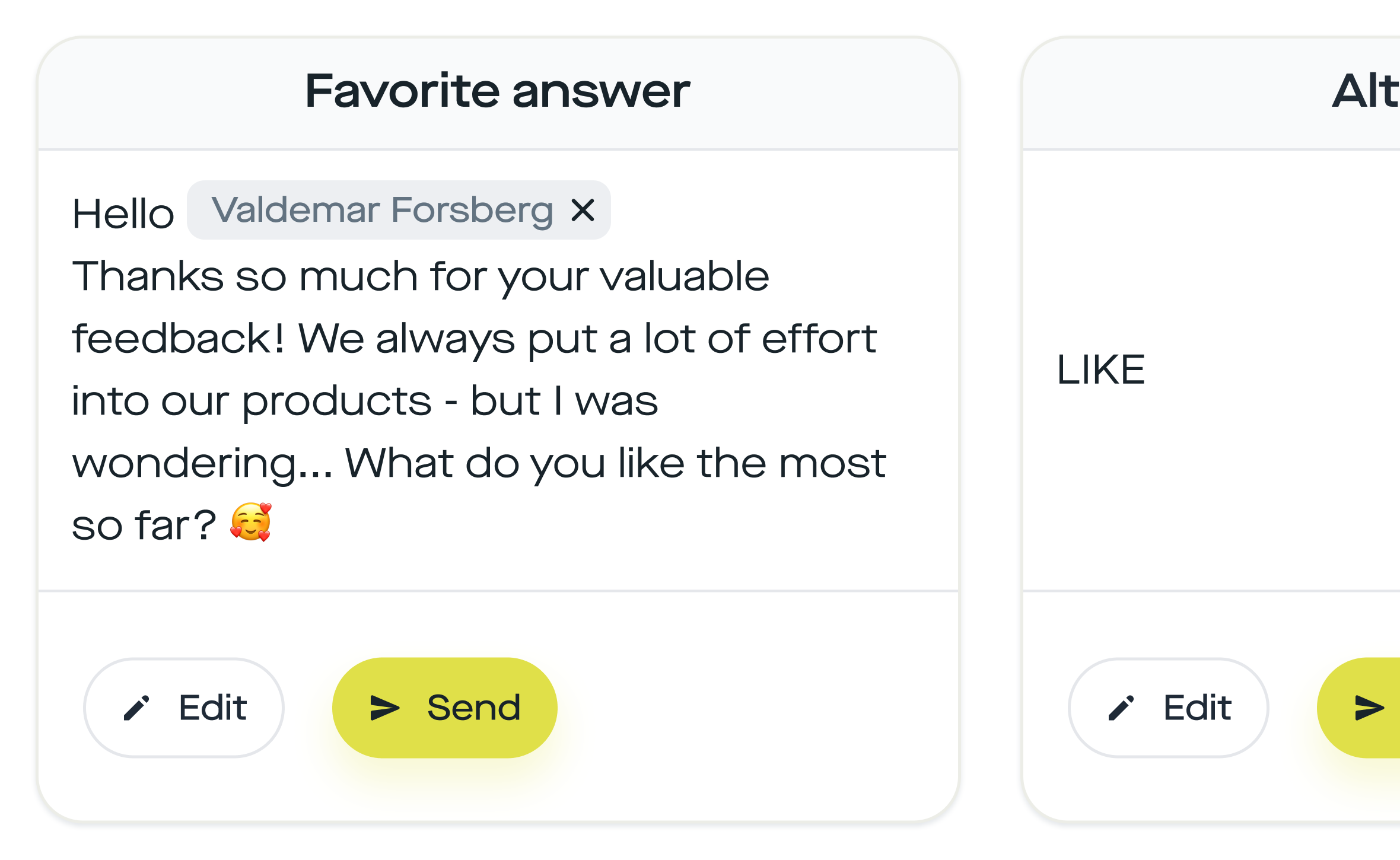
What happens in the background is more than a question mark tacked on at the end. The AI works with its own prompt set per platform, separately for Facebook, Instagram, TikTok, LinkedIn, YouTube and Google reviews, each in a variant with and without follow-up questions. It sees the parent comment if it's a reply within a thread, and it sees the post's caption. That way the follow-up question relates to what was actually said, not to a template. And it learns from your previous replies, as described in AI in community management.
You then have three ways to use the suggestions:
- Manually with 1-click replies: You see several suggestions per comment, pick one or adjust it. Ideal for getting started and for sensitive industries.
- Automated with a delay: An automation sends the best suggestion after a random wait. That's how the health customer handles 3,000 comments a day.
- With custom instructions: Custom Instructions let you control what may be asked. For example, "For health questions, never ask about symptoms, refer to a doctor instead".
When you're better off not asking a follow-up question
73% of consumers buy from a competitor when a brand doesn't reply on social media (Sprout Social Index, 2025). So replying is always mandatory. A follow-up question isn't. There are four situations where it does harm, and you should exclude them via Custom Instructions or a tag rule:
- Complaints and delivery problems. Someone who's angry wants a solution, not a conversation. This comment belongs in an escalation to a human, not in the engagement loop.
- Health, legal and financial topics. A follow-up question about symptoms or diagnoses is a liability risk. Answer, refer to a professional, done.
- Spam and trolls. A follow-up question to a troll is an invitation. That belongs in automated moderation, not in the thread.
- After the third round. Two to three follow-up questions per thread feel natural. From the fourth on, it feels like an interrogation. The AI can tell from the parent comment how deep the thread already is.
And measure the effect instead of assuming it. The median engagement rate per post has fallen to 0.30% on Instagram and 2.01% on TikTok (Rival IQ (Quid), 2026). Compare four weeks with follow-up questions against four weeks without, and don't just look at the comment count: look at replies per comment, reach after 48 hours and watch time. The 7 comment KPIs no social media manager tracks explains how to read the numbers properly.
Frequently asked questions
What is social media engagement?
Social media engagement is the sum of all interactions with your content: likes, comments, shares, saves, replies and time spent. The engagement rate puts these interactions in relation to reach or followers. In 2026, the median is 0.30% per Instagram post and 2.01% per TikTok video (Rival IQ, 2026).
What pushes the Instagram algorithm the most?
According to Adam Mosseri (January 2025), the three most important signals are watch time, likes and sends. Instagram itself also lists how quickly people like, comment, share and save. Conversations in the comments feed all three top signals, because commenters return to the post, watch it again and stay longer.
Do replies to comments count as engagement?
Yes. Replies are comments, and every platform counts them as an interaction. Across 52 million posts, Buffer measured that posts with brand replies get 21% more engagement on Instagram and 30% more on LinkedIn (Buffer, 2026). What matters is that your reply triggers another reply in turn.
How many follow-up questions per thread make sense?
Two to three. That matches a normal conversation and turns one comment into four to six more, plus the repeat visits to the post. For one replient.ai customer, volume rose from 300 to 3,000 comments per day this way. From the fourth follow-up question on, the impression tips toward interrogation, and with complaints you shouldn't ask back at all.
Are AI-generated follow-up questions allowed on Instagram and TikTok?
Yes, as long as they run through the official APIs and are real replies to real comments. replient.ai is a Meta Business Partner and works exclusively through the platforms' official interfaces, such as the Meta Graph API, the TikTok API and the YouTube Data API. What's banned are bots that mass-comment on other people's posts. 69% of consumers accept AI replies from brands if it means they get help faster (Sprout Social, 2026).
A comment is the beginning, not the end
The longer a conversation runs under your post, the more relevant it becomes to the platform, and the more often the platform distributes it. That's not theory, it's what Instagram, TikTok and LinkedIn themselves say about their ranking signals. Replying brings 21% more engagement, questions bring 36.7% more comments. A reply that asks back brings both and keeps the loop going.
Look at the last ten replies under your posts today. How many of them ended the conversation? That's exactly where your lever is.
Want to test Smart Questions on your own comments? Start for free now, 14 days free, all platforms in one dashboard.
About the author

Co-Founder, replient.ai
Thomas is a co-founder of replient.ai and works on AI-assisted comment management for social media. He writes about automation, community management and efficient comment moderation for growing brands.