Summarize this with
 ChatGPT
 Claude
 Gemini
 Perplexity
I remember the moment when my brother Markus told me, "I'm sitting on the toilet and hiding bullshit comments under our clients' ads." €20,000 ad spend per day, six brands, comments by the minute. Back then we treated it as support. As a tedious chore that just had to be done.
That was the biggest mistake we ever made. Because 73% of consumers buy from a competitor when a brand does not respond (Sprout Social, 2025). Every unanswered comment is not an open ticket. It is a lost customer. Community management is not a cost factor, it is your strongest sales channel on social media.
Social Media Comment Management: The Complete Guide 2026
TL;DR: Community management is sales, not support. 73% of consumers switch to a competitor when brands do not respond (Sprout Social, 2025). In an A/B test, active comment management increased ROAS by +48% and conversion rate by +54%. Those who treat comments as leads sell more.
Why do most brands treat comments like support tickets?
81% of consumers made impulse purchases through social media in 2025 (Sprout Social, 2025). Yet at most brands, comments land in the customer service team, not in sales. The reason: an outdated org chart. Community management is treated as a reactive task, not a proactive sales function.
The support mindset costs you revenue
The typical response to a comment like "Is this available in blue?" is: standard reply, link to the FAQ, ticket closed. But what is that comment really? A person who wants your product, who has just one question before buying. This is not a support case. This is a sales conversation.
We experienced this at our agency ourselves. Six brands, seven-figure ad budgets, hundreds of comments per day. Our community manager was a working student who reported to the support team. No one measured how many of those comments were actually buying signals. Only when we started tracking comments as leads did we understand: at least 30% of all comments under ads contain purchase intent.
The organizational gap
In most companies the community manager sits in the marketing team, or worse, in customer service. They have no access to sales KPIs. No conversion data. No overview of which comments lead to purchases. That is like blindfolding your best salesperson.
Effective community management requires a sales mindset. Anyone managing communities across different platforms, Facebook, Instagram, TikTok, LinkedIn, must recognize purchase signals, not just process complaints. That requires a rethink at the organizational level.
Why every unanswered comment costs you revenue

Every comment is a sales conversation, and the numbers prove it
The US social commerce market reaches a volume of 87 billion dollars in 2025 and will cross the 100 billion mark in 2026 (eMarketer, 2025). Social media is no longer just branding. It is a sales channel. And comments are the place where buying decisions are made, or lost.
The sofa moment: how buying decisions really happen
Daniel Bidmon described it perfectly on the EcomSecrets podcast: He watches his girlfriend on the sofa. She sees an ad, watches for 15 to 20 seconds, and then immediately goes to the comments. "And then this social proof hits." That's not an isolated case. That's the default behavior of an entire generation.
54% of Gen Z buy directly on TikTok (Sprout Social, 2025). 93% of all consumers say that online reviews influence their buying decision (Gartner, 2025). Comments under ads are nothing other than real-time reviews. Public. Unfiltered. Right next to the buy button.
From follower counts to real social media ROI
The old metrics, followers, likes, reach, tell only half the story. What really counts: How many of your comments lead to conversions? How high is the engagement on purchase-relevant questions? How much does your response speed affect ROAS?
75% of consumers spend more money with brands that offer a good customer experience (HubSpot, 2025). And 65% now expect faster responses than five years ago (Salesforce, 2025). Social media marketing that ignores these expectations leaves money on the table.
Optimizing social proof on ads: How comments boost your ROAS
How to spot buying signals in your comments
Product pages with at least one review have a 354% higher conversion rate than pages without reviews (Bazaarvoice, 2025). What applies to product pages applies just as much to the comment section of your ads. Comments with purchase intent are not background noise, they are your most valuable content.
The three types of buying signals
We internally call our comments "leads". Because a comment is nothing other than a prospect who is currently at a certain stage: they want to buy, they may still have a question. From our experience there are three clear types of buying signals:
1. Direct purchase intent: "Where can I order this?" / "Is there a discount code?" / "Do you ship to Austria?" These comments are ready-made leads. Every minute without a reply reduces the likelihood of a purchase. Consumers expect a reply within six hours (Salesforce, 2025).
2. Objection with interest: "Is it really as good as in the ad?" / "Sounds too good to be true." These are not haters. These are skeptical prospects. Whoever responds here with authenticity and data converts.
3. Social validation: "Has anyone tried this yet?" / A friend gets tagged. This is social proof in real time. A good reply turns the comment into a public testimonial.
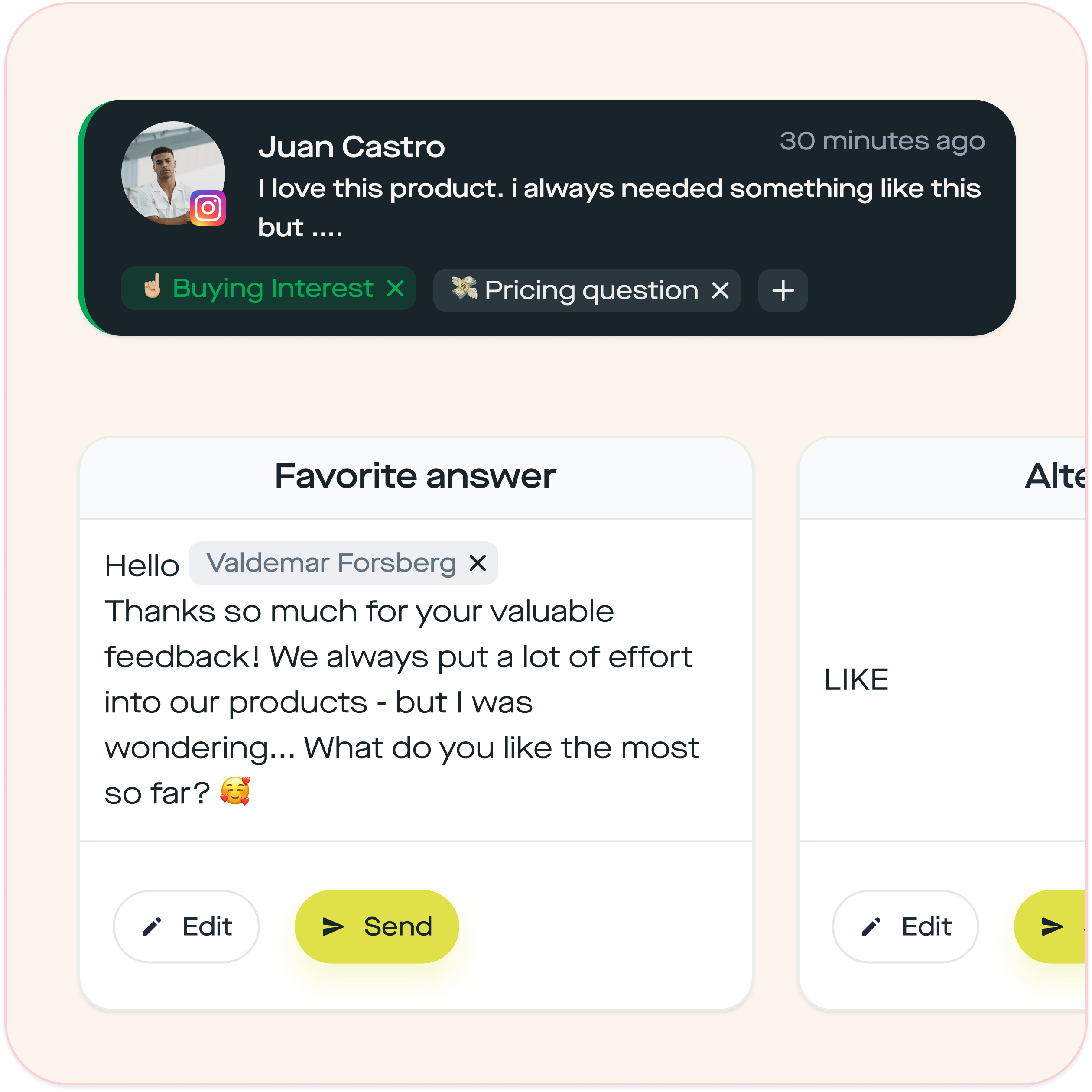
Conversational Commerce: From comment to DM
This conversational commerce, start the conversation in the comments, move it into DMs, then hold a one-on-one sales conversation there. We are working on this very intensively right now. The trend is clearly moving in this direction: build trust publicly, close privately.
UGC ads achieve a 4x higher CTR and a 50% lower CPC (inBeat/Shopify, 2025). When you then move these interactions into DM conversations through smart monitoring, the comment becomes the start of a sales funnel. That is social media community management on a completely new level.
One-click replies for faster community management
The ROAS proof: What happens when you reply?
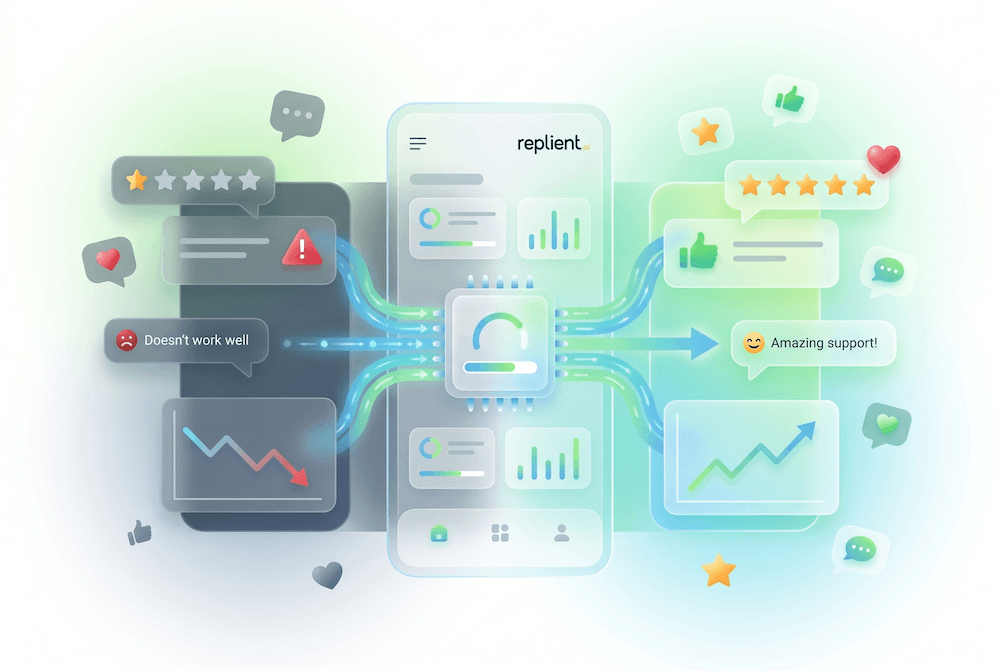
In Zauberfein's A/B test, ROAS increased by 48%, conversion rate by 54%, and CPA dropped by around 40% with the same ad, same budget and same time period (internal case study, 2025). The only difference was whether comments were answered or not. This is the strongest evidence that community management is a sales lever.
The Zauberfein A/B test in detail
Same ad. Same budget. Same time period. In the unmanaged variant, exactly what always happens happened: a troll writes "Don't buy this, it's fake!" and the comment gets 50 likes. Every potential buyer reads that. ROAS collapses.
In the managed variant? Objection handling, honest answers, one-on-one with the commenters. The community manager didn't just moderate, she sold. Without clumsy sales language. With authenticity and real answers to real questions.
Zauberfein case study: Read all the details of the A/B test
It doesn't just work for one brand
SNOCKS saves half a full-time equivalent (0.5 FTE) through effective, AI-powered community management, just from automated comment management. And Health Routine? A support agent was out, an immediate solution was needed, 90% less effort. These are not isolated cases. This is a pattern.
A US health brand started at 300 comments per day and is now at 3,000 per day, simply thanks to AI-powered smart questions that always ask follow-ups. Tenfold engagement. Not because more people are commenting, but because every reply triggers a new interaction.
Community management as a sales strategy: How you put it into practice
65% of all buyers worldwide base their purchase decision on user generated content (Bazaarvoice, 2025). That means: Your comment section is not optional. It is an active sales channel. Here are five steps to turn community management into a sales machine, without it smelling of marketing.
1. Classify comments as leads
Stop sorting comments into "positive", "negative" and "neutral". Sort by intent: purchase signal, objection, social proof, spam. A community manager who recognizes purchase signals is more effective than one who only moderates. Tools with AI-powered tagging make this scalable.
2. Bring response time under six hours
Consumers expect a reply within six hours (Salesforce, 2025). With ads this is even more critical: most impressions happen in the first few hours. A Friday-evening comment "Don't buy this, it's fake!" with 50 likes that stays unanswered until Monday, that is a ROAS killer. We experienced it ourselves.
3. Handle objections instead of deleting
93% say that reviews influence their buying decision (Gartner, 2025). Deleting negative comments creates distrust. Professional answers create trust, not just with the commenter, but with all the silent readers. The agency experience shows: honest objection handling converts better than any copy.
4. From comments to DMs, build the funnel
Start the conversation in the comments, move it to DMs, and conduct the sales talk there. This conversational commerce approach works especially well for products that require more explanation. On TikTok, Instagram and Facebook you can seamlessly move public interactions into private conversations.
5. Measuring results: Community management as a KPI
Don’t just measure response time and response rate. Measure the impact on ROAS. Compare managed vs unmanaged Ads. Track which comment replies lead to clicks and conversions. Only when community management has its own sales KPIs will it be taken seriously as a revenue function.

Frequently asked questions about community management as a sales channel
What is the difference between community management and customer service?
Customer service reacts to problems. Community management builds customer relationships proactively, and recognizes buying signals. 73% of consumers switch to a competitor when brands do not respond (Sprout Social, 2025). A good community manager does not just moderate, they sell, through authenticity and fast, helpful answers across different platforms.
How do I measure the ROI of community management?
Compare managed vs unmanaged Ads in an A/B test. In the Zauberfein test ROAS rose by +48% and the conversion rate by +54% (own case study, 2025). Also track response time, the share of purchase-signal comments answered, and the click-through rate on links in your comment replies.
Zauberfein case study: A/B test in detail
Do I need tools for community management on social media?
From 50 comments per day automation becomes worthwhile. From 200+ manual management without tools is hardly scalable. AI-powered solutions detect purchase signals, prioritize comments and suggest replies. SNOCKS thus saves 0.5 FTE. The trick: the tool must understand sales logic, not just moderate content.
Does community management work as a sales channel on all platforms?
Yes, with different dynamics. On Facebook and Instagram, ad comments are the primary sales touchpoint. TikTok is growing rapidly: 54% of Gen Z buy there (Sprout Social, 2025). LinkedIn is suited for B2B leads. YouTube comments influence longer buying decisions. The basic rule stays the same: replying sells.
How quickly should a community manager reply to comments?
Within six hours, that is what consumers expect (Salesforce, 2025). With performance ads, every hour counts, because most impressions come early. A negative comment that stays unanswered for eight hours is read by thousands of potential buyers.
Your comment section is your sales floor
The data is clear: 73% buy from competitors if you do not answer. 81% make impulse purchases via social media. And active community management increases ROAS by up to +48%, proven in a controlled A/B test. Community management is not support. It is your most underrated sales channel.
Start treating comments as leads. Get your response time under six hours. Measure the ROAS impact. And stop pushing community management into the support team. The brands that understood this sell more. Those that do not understand lose customers to those who respond.
Want to see how this works in practice? Start for free now – 14-day free trial.
About the author

Thomas Danninger
Co-Founder, replient.ai
Thomas ist Co-Founder von replient.ai und Experte für KI-gestütztes Social Media Kommentar-Management. Er schreibt über Automatisierung, Community Management und effiziente Kommentar-Moderation für wachsende Brands.