Summarize this with
 ChatGPT
 Claude
 Gemini
 Perplexity
700 comments a day. Three hours of manual work. That was everyday life when we managed ten brands with our agency, including DJ Ötzi. Every day the same question: Who answers all of this? And what happens to ROAS if no one responds?
The answer came faster than expected. 30% of all comments under brand ads are negative (industry study, 2024). Without active management, your CPM rises by 30 to 40%. And the comment section – the place where 93% of consumers confirm their purchase decision (Podium, 2024) – becomes a conversion killer instead of a sales channel.
Social Media Comment Management: The Complete Guide 2026
TL;DR: About 30% of comments under ads are negative. Without replies your CPM rises by 30 to 40%. Active comment management increases ROAS by up to 109% and reduces cost per action by 26% (industry study, 2024). Social proof in the comment section is the most underestimated performance lever.
What is social proof, and why does it determine your ad performance?
93% of consumers say that online reviews influence their purchase decisions (Podium, 2024). Social proof is the psychological principle behind it: people take their cues from the behavior of others, especially when uncertain. On ads, comments are the most visible form of social proof – and the only one you don't fully control.
Comments are the reviews of your ads
Imagine you are scrolling through Instagram. An ad catches your eye. What do you do? Exactly – you click on the comments. 97% of consumers read reviews before they buy. 41% do it every time (BrightLocal, 2026). Comments under ads are nothing other than public, real-time reviews.
The difference from classic review portals: these reviews sit right where the purchase decision is made. No detour via a review portal. Right under your ad, right before the click on "Buy now".
The algorithm is watching
Meta evaluates the quality of your ads based on user interactions. Below-average quality rankings increase your costs by 20 to 50% (Meta Ad Relevance Diagnostics, 2025). Positive comments signal relevance. Negative ones without a reply signal the opposite. The algorithm punishes not only bad creatives – it punishes neglected comment sections.
Why every unanswered comment costs you revenue
The 30% problem: Why almost one in three ad comments is negative
Around 30% of comments under brand ads are negative (industry analysis of over 5,000 campaigns, 2024). This is not an outlier, this is the average across thousands of campaigns. Without a response, CPM rises by 30 to 40% (industry study, 2024). That means your budget is being wasted, not because your creative is bad, but because your comment section remains unmanaged.
The Zauberfein proof
We tested it ourselves. The same winning ad. €7,000 budget each. Everything identical – except for the comment management. With the unmanaged variant, the top comment was: "This is just a run-of-the-mill product from the hardware store for five euros, don't buy it." 50 likes. Everyone read it.
With the managed variant? Objection handling, honest replies, one-on-one with the commenters. The result: around 50% better ROAS and 40% cheaper customer acquisition. "The results were really wild. Even surprised us."
Zauberfein case study: all the details of the A/B test
DJ Ötzi: When 400 spam comments per day destroy the community
DJ Ötzi: 1,000 comments per day, 400 of them spam. Fake accounts imitated DJ Ötzi and wrote: "Message me on Telegram!" Fans fell for it and sent money. After automatically hiding and blocking the spam accounts, something unexpected happened: "People dare to comment more again." The real community came back.
94% of consumers avoid brands after negative reviews (ReviewTrackers via industry study, 2024). What applies to reviews applies just as much to comment sections full of spam and hate.
The A/B test that changed everything: +109% ROAS
In a controlled A/B test, active comment management achieved +109% ROAS, +49% higher average order value ($141 to $210) and +47% more purchases, at 29% lower cost per result (controlled A/B test in eCommerce, 2024). This is not a marketing narrative. This is a controlled experiment with identical conditions.
The math behind it
On the EcomSecrets podcast, Daniel Bidmon boils it down to a simple formula: "When some troll comments something under the creative, it pulls the ROAS down right away." The other way around: if your ROAS is normally 3 and you achieve a 50% uplift through active management, you land at a ROAS of 4.5.
That is not a small boost. At €50,000 monthly ad spend, that is the difference between €150,000 and €225,000 in revenue. €75,000 difference, from comments.
Why the conversion rate increases
Whoever replies to comments showing purchase intent reaches a conversion rate of 11% (industry study, 2024). At the same time, the cost per action drops by 26%. The logic is simple: when someone asks under your ad "Do you deliver to Austria?", that is a warm lead. A quick reply converts. No reply loses.
Why the comment box is your sales pitch
How does social proof affect the Meta algorithm?
Below-average quality rankings in the Meta Ads system increase your costs by 20 to 50% (Meta Ad Relevance Diagnostics, 2025). What many don't know: the algorithm doesn't only assess click-through rates and landing page quality. It also assesses how users interact with your ad – and that includes comments. Positive comments outperform negative ones on CTR with 97–98% confidence (independent A/B study, 2024).
The engagement loop
This is how the cycle works: you reply to a comment. The commenter replies back. Others see the conversation and comment as well. The algorithm sees high interaction, relevant content, more reach. More reach means cheaper CPMs. Cheaper CPMs mean better ROAS.
And what happens if you don't reply? Exactly the opposite. Without comment replies, the CPM rises by 30 to 40% (industry study, 2024). Silence is not a neutral action in the algorithm.
Anyone who thinks performance marketing ends with the creative and the audience overlooks the third factor: the comment section as an algorithmic signal. No creative test in the world helps if under your top-performing ad there is a negative comment with 50 likes.
TikTok Spark Ads: Why social proof is built in
TikTok Spark Ads achieve 37% lower CPA ($14.62 vs. $23.18), 142% higher engagement rate and 159% higher conversion rate compared to standard ads (AMRA & ELMA, 2025). The reason? Spark Ads use existing organic posts – including all likes, comments and shares. The social proof is built in.
Applying the principle to Meta
On Facebook and Instagram there is an equivalent: the "Use existing post" function when creating ads. Instead of creating a new ad, you promote a post that already has likes and positive comments. Same effect as with Spark Ads: you don't start at zero social proof.
If you don't use this feature, you are giving away one of the easiest performance levers in your entire ad account. A post with 200 positive comments used as an ad performs differently than a fresh ad with an empty comments section. Sounds obvious? Still, most don't do it.
Managing negative comments under ads
5 strategies to maximize social proof on your ads
73% of consumers buy from competitors when a brand does not respond (Social Media Industry Report, 2025). Social proof on ads is not accidental, it can be systematically built and protected. Here are five strategies that have proven effective in our practice.
1. Respond, don't ignore
73% switch to the competition if you don't reply. But there is also the flip side: a complaint that gets answered increases customers' willingness to recommend by 25% (Convince & Convert, 2024). Replying has an effect not only on the individual commenter. Hundreds of passive readers see your reaction and draw conclusions.
2. Address negative comments, don't delete them
80% of consumers trust brands more when they respond to negative reviews (Northwestern University via Trustmary, 2025). Deleting creates distrust. Professional objection handling creates trust. Exception: spam and fraud – those have to go. Hiding harmful comments increases conversions by up to 34% (industry study, 2024).
3. "Use existing post" for ad campaigns
Promoted posts with existing social proof perform better than fresh ads without comments. Five existing product reviews can increase conversions by 270% (Spiegel Research Center via Trustmary, 2025). Why start at zero when you can bring existing social proof along?
4. Detect purchase intent and convert
Replying to comments with purchase intent brings a conversion rate of 11% (industry study, 2024). Questions like "Is there a discount code?", "Do you deliver to Germany?" or "Which size do you recommend?" are not comments. Those are leads.
5. Turn positive comments into reviews
A bacon manufacturer solved this cleverly: positive comments automatically trigger a DM – with a request for a Google review and a Trustpilot link. "That was the first time I would have thought you could even do that. But it's actually really smart." Social proof creates social proof. A cycle.
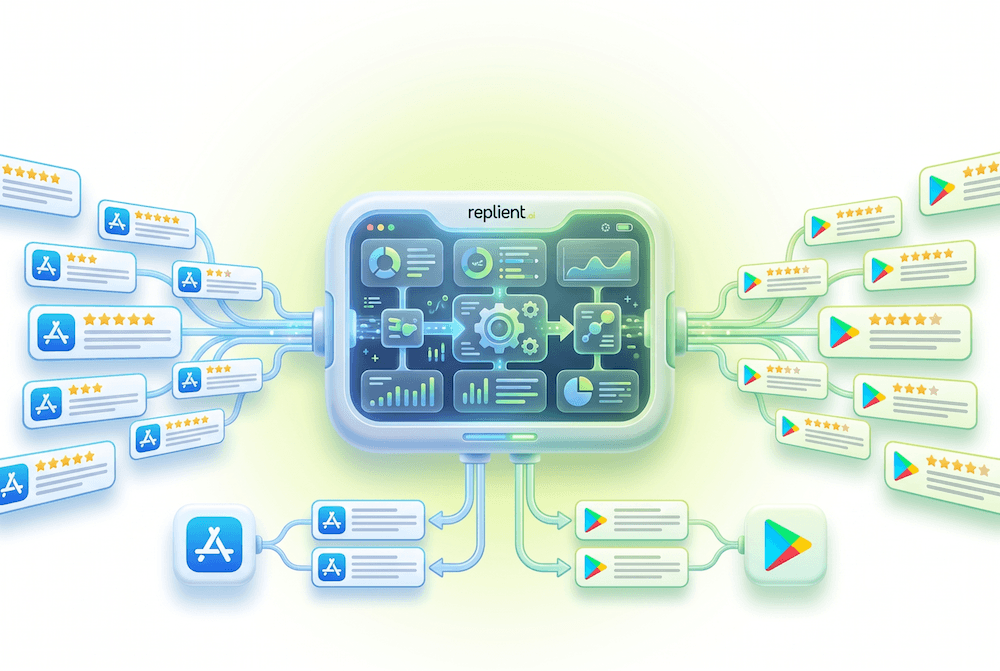
Automating comment moderation: how it works
When does automated comment management pay off?
At 200 comments per day and 25 seconds per reply you spend 1.5 hours a day on manual work. From 50 comments per day, automation pays off, not just because of time savings but because of consistency and speed. After all, 73% of consumers expect a response within 24 hours (Social Media Industry Report, 2025).
From 3 hours to 30 minutes
"During that time, when we had ten different brands at the agency that were seven-figure, we had 700 comments a day. Three hours per day." After switching to AI-powered management: 30 minutes. The tool didn't come about because we wanted to build a SaaS product. Markus built it "so I didn't have to answer comments on the toilet."
The ROI calculation
A student assistant for comment management costs 1,500 to 2,000 euros per month. With 200 comments a day that is about 1.5 hours of pure typing work, without context switching and without quality control. At the same time, active management increases ROAS by at least 34%, and up to 109% in the best case. The investment is not the question. The question is how much ROAS you lose without management.
Social proof in the DACH market: which numbers convince?
40% of German consumers have already bought a product after seeing it on social media (Germany Social Commerce Market Databook, 2025). The German social commerce market is growing to 8.46 billion dollars by 2030 – with a CAGR of 6.5%. Social proof is no longer a niche topic in the DACH region. It is mainstream.
German consumers are more skeptical, and that is an advantage
49% of consumers trust online reviews as much as personal recommendations (BrightLocal, 2026). In the DACH region, consumers tend to be more critical. That is exactly why social proof carries more weight here. Whoever can show genuine, authentic comments to a skeptical target audience has a disproportionate edge in trust.
And that is exactly why comments under ads are especially effective in the DACH region. In a market where trust has to be earned, every honest brand response to a critical comment is worth its weight in gold.
Frequently asked questions about social proof on ads
What is social proof in marketing?
Social proof is the psychological principle that people take their cues from the behavior and opinions of others. In marketing, this shows up in reviews, testimonials, user numbers and, of course, comments under ads. 93% of consumers say that reviews influence their purchase decision (Podium, 2024).
How do comments affect the ROAS of your ads?
Comments are public social proof. Positive comments increase trust and click-through rate. Negative comments without a response decrease both. In controlled A/B tests, active comment management increased ROAS by up to 109% (industry study, 2024). At the same time it reduced cost per action by 26%.
Should you delete or respond to negative comments under ads?
Respond – in most cases. 80% of consumers trust brands more when they respond to negative reviews (Northwestern University via Trustmary, 2025). Deleting comes across as intransparent. The only exception: spam, fraud and hate speech. Those you should hide – it increases conversions by up to 34% (industry study, 2024).
At how many comments per day does automation become worthwhile?
Automation becomes useful at 50 comments per day. Until then, manual management with a clear structure is sufficient. At 200 comments per day you already spend 1.5 hours manually, so an AI tool quickly pays off. At 300+ comments, AI-powered management is practically mandatory.
Does social proof work on all social media platforms?
Yes, but differently. On Facebook and Instagram, ad comments are the primary social proof channel. TikTok Spark Ads carry existing social proof along automatically – hence a 159% higher conversion rate than standard ads (AMRA & ELMA, 2025). LinkedIn and YouTube work similarly, just with different dynamics.
How quickly should you respond to comments under ads?
73% of consumers expect a response within 24 hours (Social Media industry report, 2025). With ads, speed counts even more, because most impressions occur in the first hours. A negative comment left unanswered overnight can deter thousands of potential customers.
Further reading
- Social Media Comment Management: The Complete Guide 2026
- Automating comment moderation: how AI moderation works
- Why every unanswered comment costs you revenue
- The comment box is your sales pitch
Your ROAS is in the comment section
The data is clear. 30% of ad comments are negative. 73% of consumers buy from the competition if you do not respond. And active comment management increases ROAS by up to 109%. This is not a marketing trend. These are repeatable, measurable results from controlled tests.
Social proof on your ads does not appear by itself. It appears when you reply, counter objections, remove spam and convert purchase signals. The comment section is the most underestimated performance lever in your entire ad account. If you ignore it, you leave revenue on the table.
Want to see how comment management boosts your ROAS? Start for free now – 14-day free trial.
About the author

Thomas Danninger
Co-Founder, replient.ai
Thomas ist Co-Founder von replient.ai und Experte für KI-gestütztes Social Media Kommentar-Management. Er schreibt über Automatisierung, Community Management und effiziente Kommentar-Moderation für wachsende Brands.