Summarize this with
 ChatGPT
 Claude
 Gemini
 Perplexity
You test creatives, split audiences, optimize landing pages. Your tracking is clean, your budget is scaling. But your comment section? You treat it like an afterthought. There, something happens that no creative in the world can replace: real sales conversations.
34.7% of all comments under ads contain a clear purchase intent (BrandBastion). Questions about prices, availability, delivery terms – these are not casual interactions. These are buying signals. And every unanswered buying signal is a lost customer – on Facebook, Instagram, TikTok, LinkedIn, YouTube and Google Reviews alike.
TL;DR: The comment section under your ads is not a support channel, it is a public sales conversation. 34.7% of comments show purchase intent. If you respond, you increase conversion rate by over 23%. If you ignore it, you give revenue away to brands that react faster.
Why the comment section is a sales channel
34.7% of all comments under ads contain a purchase intent – questions like „How much is this?“, „Is there a discount code?“ or „Do you deliver to Austria?“. These are not curious passers-by. These are potential customers in the middle of the decision process. And they write to you publicly – in front of hundreds of silent readers.
Thomas Danninger, co-founder of replient.ai, calls it by its name on the EcomSecrets Podcast: „The customer who writes a comment is in a certain state. They want to buy, may still have a question, some objection that you can quickly clear out of the way.“ In the past this happened at the store counter. Today it happens under your ads.
The crucial difference: it's public
A classic sales conversation is private, a salesperson and a customer. A comment under an ad is a sales conversation in front of an audience. When you reply helpfully to a user, hundreds more read it. Every good answer is also product advice for all the silent readers.
Daniel Bidmon describes a behavior on the podcast that everyone knows: „My girlfriend sees an ad, looks at the creative – 15, 20 seconds – and then: comments! And then she reads, reads, reads… and then that social proof hits.“ The comment section is the last instance before the purchase decision.
Comments are leads, treat them as such
The replient.ai founders made a shift in perspective that makes the difference: „We call them leads, our comments, because that's really nothing else – it's a prospect.“ When you treat every comment with a buying signal as a lead, your entire approach to the comment section changes.
Instead of thinking: „That's community management“ – you think: „That's a warm lead that needs a reply.“ And exactly this mindset separates brands with strong ROAS from those that burn budget.
More on the basics: Why every unanswered comment costs you revenue

Social proof: Why comments are more effective than any landing page
92% of consumers trust recommendations from other people – even from strangers – more than direct brand communication (Nielsen Global Trust in Advertising). And 75% of buyers read reviews and comments before making a purchase decision (BrightLocal, 2024). This applies not only to Google Reviews – but also to comments under ads. Every positive comment under your ad is social proof in real time.
The comments section as a public review section
Keep in mind: on your landing page you control the testimonials. In the comment section you don't. That is exactly what makes it more credible. When someone writes under your ad „Ordered it last week, amazing quality!“ and you reply with an honest thank-you – that is stronger than any staged review.
Markus Felder, co-founder of replient.ai, describes it like this: „Every comment is like a review. It brings an enormous amount of social proof when ten people write underneath: Amazing product, definitely buy it!“ The difference: these reviews sit right where the purchase decision is made – under the ad, not on a separate page.
Negative comments have a threefold impact
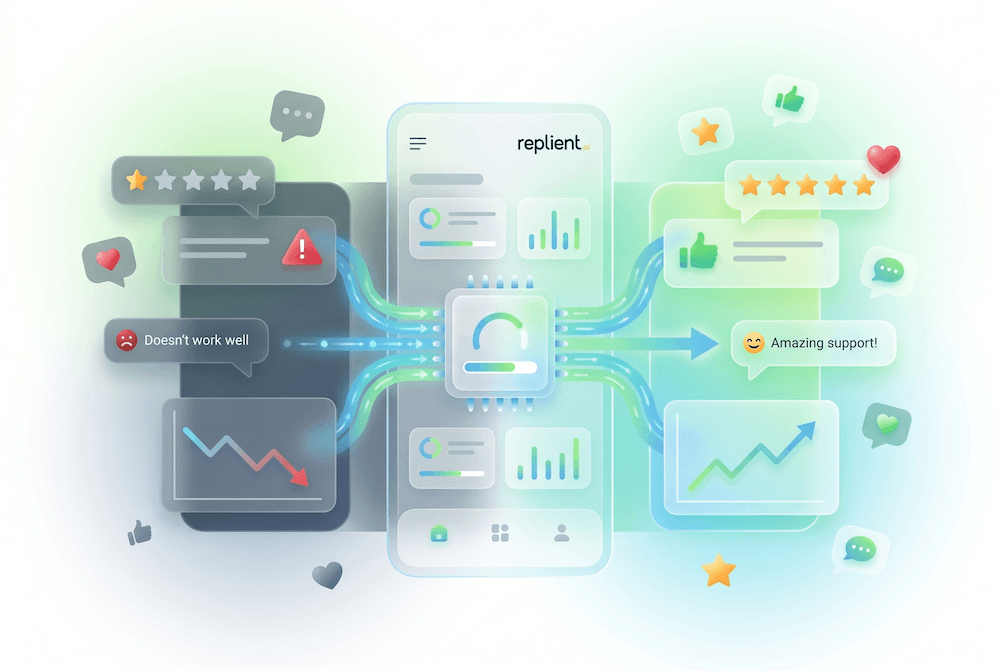
A single negative comment can immediately drag down the ROAS of a top-performer ad. Markus describes a weekend scenario on the EcomSecrets Podcast that every performance marketer knows: „On Monday you realize: our top-performer ad now has a comment – ‚Don't buy this, it's fake!‘ – with 50 likes. And the ROAS has tanked.“ Stopped moderating on Friday, got the bill on Monday.
The problem is made worse by the algorithm: since October 2025 Meta confirms that negative customer feedback directly increases CPMs in the ad auction system (Meta Business Help Center). Passive readers see the negative comment, see no brand reply and draw their own conclusions. An unanswered negative comment signals: „This brand doesn't care.“ Or worse: „The comment is true.“
What happens when you respond to buying signals: The numbers
According to an industry analysis, campaigns where comments showing purchase intent were actively answered achieved a conversion rate of 11.36% compared with 9.21% for campaigns without responses. That is a difference of over 23%. With an ad spend of 50,000 euros per month, that is thousands of euros more in revenue, without a single cent of additional budget.
Zauberfein: +48% ROAS through comment management
The e-commerce brand Zauberfein delivers the hardest proof. In a controlled A/B test, the identical ad ran with an identical budget – once with active comment management, once without. Result: +54% conversion rate and +48% ROAS (replient.ai case studies).
Thomas Danninger describes the test on the podcast: „On one you have the top comment: ‚Don't buy this, it's fake!‘ with 50 likes. On the other side you have objection handling and you go one-on-one with the customer. Conversion rate, everything went up.“
The multiplier effect: Hundreds read each comment
Daniel Bidmon nails it on the podcast: „Very few people actually write something underneath. When one person writes it, hundreds are probably thinking the same.“ Every reply to a buying-signal comment simultaneously answers the same question for hundreds of passive readers. That is scalable sales advice.
The data confirm it: An analysis of over 2 million posts shows that brand replies to comments increase engagement by +9% (Facebook) to +42% (Threads) (State of Social Media Report, 2025). Replies do not only affect the individual commenter, they signal to the algorithm that your content generates interaction, and are rewarded with more reach.
More on the case study: Zauberfein case study: +54% conversion rate
Why most performance marketers still don't respond
73% of consumers switch to a competitor if a brand does not respond on social media (Social Media Consumer Index, 2025). Yet 74% of all customer inquiries on social media remain completely unanswered (Social Media Benchmark Report, 2025). How does that add up?
The ownership problem
In most companies the comment section falls between the cracks. Performance teams say: „That's community management.“ Community managers say: „Those are ad comments, they belong to the paid team.“ Support says: „We handle tickets, not social comments.“ Result: nobody feels responsible.
Markus Felder sums up the problem: „If you're a performance marketer and you think the comments under the post are for some customer support department… then you don't have it under control. Because when a customer sees your ad and the creative convinces them: the first thing they do is click into the comments.“
The wrong prioritization
Teams invest weeks in creative iterations and A/B tests, but zero minutes in the comment section of the same ads. It's like setting up a flagship store perfectly, hiring the best window dresser, and then sending the sales staff home.
The irony: the part of your ad that users trust the most, the comments from other users, is also the part you control the least. Unless you respond.
Conversational Commerce: From comment to purchase
Conversational commerce describes the trend that purchase decisions are increasingly made in chat-like interactions – in DMs, in messenger apps and in comment sections. The global market for conversational commerce is growing from 11.26 billion dollars (2025) to 20.28 billion dollars by 2030 – a CAGR of 12.6% (Mordor Intelligence, 2025). What many overlook: the comment section is the entry level of this trend.
Comment-to-DM: The natural sales funnel
The smartest brands use comments as top-of-funnel and then continue the conversation in DMs. Thomas Danninger explains the workflow: „You try to get the leads – we call them leads – over into the DMs. There you have the chance to sell it to them in a one-on-one conversation.“
The process: Someone comments under an ad with a product question → you reply publicly (all readers benefit) → you move the conversation to DMs for personalized advice → purchase completed. No landing page detour, no form hurdle. Directly from interest to sale.
Scaling with AI: From 300 to 3,000 comments per day
A US health brand scaled from 300 to 3,000 comments per day using replient.ai's Smart Questions feature (replient.ai customer data). Manually that would have required a team of 10 to 15 people. The AI automatically asked follow-up questions, users replied, the algorithm rewarded the engagement with more reach. The result: tenfold engagement volume with the same staffing.
More on this: AI in community management

How to integrate comments into your performance marketing
Comment management is not an extra, it belongs in the same workflow as creative testing and audience research. Here are the concrete steps to activate the comment section as a sales channel.
1. Prioritize purchase-signal comments
Not every comment needs the same attention. Comments with purchase intent, like price questions, availability inquiries, and discount code questions, have the highest priority. At Zauberfein the conversion rate for answered purchase-signal comments was 23% higher than without an answer.
2. Reply within the first hour
Most impressions of an ad occur in the first hours. If in this phase a negative comment remains unanswered, thousands of potential customers see it. 32% of consumers expect a reply within an hour, and 73% within 24 hours (Social Media Benchmark Reports, 2025). With ads every minute counts, because every reader who sees the unanswered comment is a potential conversion loss.
3. Make objection handling public
When someone writes „You can get this cheaper on Amazon“ – then your public reply is not a justification, but a sales opportunity. Explain the added value, point to quality differences, offer a discount code. Hundreds of readers see your reply and think: „They care. They stand behind their product.“
4. Use AI for scaling, not for shortcuts
SNOCKS handles over 300 comments per day in under an hour with replient.ai (replient.ai case studies). That saves 0.5 full-time positions. But the point is not time savings alone – it is that every comment gets a reply that fits the brand voice. AI tools learn from your previous replies and your website. The replies sound like they come from your team, not from a bot.
More on choosing a tool: Social media comment tools compared 2026
Frequently asked questions
Are comments under ads really a sales channel?
Yes. 34.7% of all comments under ads contain direct purchase intent. In an A/B test by Zauberfein, the conversion rate rose by 54% just from actively replying, with the ad and budget unchanged. The comment section is not a side channel. It is the place where purchase decisions are influenced.
How does social proof in comments affect ad performance?
92% of consumers trust recommendations from other people more than brand communication (Nielsen), and 75% read reviews and comments before the purchase decision (BrightLocal, 2024). Positive comments under an ad act like real-time reviews. Negative comments without a brand reply signal a lack of engagement. Both affect the conversion rate – and therefore your ROAS.
What is the difference between comment management and community management?
Community management covers all interaction with your audience: DMs, Stories, groups, events. Comment management focuses on public comments under posts and ads. For performance marketers, comment management is the more relevant area, because ad comments directly affect campaign performance.
What is conversational commerce?
Conversational commerce describes buying through chat-based interactions in DMs, messenger apps and comment sections. Brands use the comment section as an entry point: answer a public question, then move the conversation to DMs for personalized advice and purchase. This is the natural sales funnel on social media.
When is a comment management tool worth it?
Under 50 comments per day can be handled manually. From 100 you need automation for routine tasks. From 300 comments daily, AI-supported management becomes a must, SNOCKS processes this volume in under an hour. The crucial point is: when your ad budget grows, comment volume grows with it.
Further reading
- Social Media Comment Management: The Complete Guide 2026
- Why every unanswered comment costs you revenue
- Automating comment moderation: How AI moderation works
Your comment section is your best salesperson, if you let it
Performance marketing does not end at the click on the ad. It does not end on the landing page either. For many users it ends in the comment section, where they read real opinions, ask questions and decide whether to trust you.
34.7% of your ad comments are purchase signals. Every reply to a purchase signal is a sales conversation, public, scalable and visible to hundreds of readers. If you ignore the comment section, you ignore the most revenue-generating part of your funnel.
Want to see how comment management boosts your ROAS? Start for free now – try it free for 14 days.
About the author

Thomas Danninger
Co-Founder, replient.ai
Thomas ist Co-Founder von replient.ai und Experte für KI-gestütztes Social Media Kommentar-Management. Er schreibt über Automatisierung, Community Management und effiziente Kommentar-Moderation für wachsende Brands.