


Friday afternoon, end of the workday. You shut down your laptop. On Monday you open the Ads Manager and see: your top-performing ad has a new comment. "Don't buy this, it's fake!" with 50 likes. ROAS dropped over the weekend. Now what? Hide it? Reply? Ignore it and hope it disappears?
30% of all comments under brand ads are negative (benchmark analysis of 5,000 campaigns, 2024). Without a response your CPM rises by 30 to 40%. But reflexive deletion is just as dangerous, 80% of consumers trust brands more when they respond to criticism (Northwestern University via Trustmary, 2025). The right question is not whether you respond, but how.
Social Media Comment Management: The Complete Guide 2026
TL;DR: 30% of ad comments are negative. Not every negative comment needs the same response. Spam and fraud: hide immediately (+34% conversions). Legitimate complaints: reply publicly (+80% trust). Troll comments without substance: hide, do not delete. This framework shows you when each strategy protects your ROAS.
Why are negative comments under ads so dangerous?
94% of consumers avoid brands after negative reviews (ReviewTrackers, 2024). Comments under ads have the same effect, only more direct. They sit where the purchase decision is made: under your ad, right before the click on "Buy now". A single unmanaged comment can deter thousands of potential customers.
The algorithm penalizes neglected comment sections
Meta evaluates the quality of your ads based on user interactions. Below-average Quality Rankings increase your costs by 20 to 50% (Meta Ad Relevance Diagnostics, 2025). Negative comments without a brand response signal to the algorithm: poor user experience. Less reach. Higher CPMs. Worse ROAS.
This is not marketing theory. In a controlled A/B test with the e-commerce brand Zauberfein, the managed ad variant achieved around 50% better ROAS and 40% cheaper customer acquisition, with identical budget and identical creative (replient.ai case studies).
The weekend effect: stop on Friday, regret it on Monday
We know this scenario from our agency days. Six brands, €20,000 ad spend per day, comments every minute. "On Monday you realize: Our top-performing ad now has a comment, 'Don't buy this, it's fake!' with 50 likes. And the ROAS has tanked." A whole weekend of budget burned because no one was watching the comments.
63% of consumers expect a response to negative ad comments within one hour (Resolver Consumer Survey, 2024). In ads, the first hours are decisive, most impressions occur during the launch phase. A negative comment left overnight reaches thousands of readers.
Why every unanswered comment costs you revenue
The 4 types of negative comments, and why the distinction matters
Not every negative comment is the same. The right reaction depends on the type. Anyone who treats everything the same, deleting everything or replying to everything, gets it wrong. From hundreds of onboarding conversations with e-commerce brands we identified four clearly distinguishable types.
Type 1: Trolls and haters, provocation without substance
"That's just a run-of-the-mill product from the hardware store for five euros." No purchase experience, no specific objection, just provocation. Trolls want reactions, not solutions. They never bought or tried the product. But their comments collect likes, because negativity on social media drives engagement faster than anything else.
Recommendation: Hide (do not delete). The comment remains visible to the author, but not to other users. No Streisand effect, no public confrontation.
Type 2: Legitimate complaints, real customers with a real problem
"Delivery took three weeks, support does not respond." That is not a troll. That is an unhappy customer who deserves a solution. And hundreds of onlookers are watching how you handle it.
Recommendation: Reply publicly, then move the conversation to DMs. The public reply shows all onlookers: this brand cares. The private message solves the individual problem. From one of our onboarding calls: a bacon maker does exactly that, continuing negative comments via DM, "so it's not all so public when it's about a delayed delivery."
Type 3: Spam and fraud, scam links and fake accounts
We manage DJ Ötzi's channels: 1,000 comments per day, 400 of them spam. Fake accounts impersonated DJ Ötzi and wrote, "Message me on Telegram!" Fans fell for it and transferred money. After automated hiding and blocking something unexpected happened, "people felt more confident commenting again." The real community came back.
Recommendation: Immediately hide and block. No room for negotiation, no discussion. Spam and fraud should be removed, automated and in real time.

Type 4: Competitor attacks, targeted negative campaigns
More subtle and harder to spot. Accounts without profile pictures that leave similar comments under several of your ads: "There are better alternatives", "Overpriced". No concrete experiences, no specific feedback, just targeted undermining.
Recommendation: If clearly identifiable, hide. If it looks like genuine criticism, reply publicly and factually. The reply is aimed at the onlookers anyway, not the commenter.
When you should hide comments, and why "hide" is better than "delete"
Hiding harmful comments increases conversions by up to 34% (analysis of social ad campaigns, 2024). The decisive difference: hiding is not deleting. A hidden comment remains visible to the author. They do not notice that their comment is invisible to others. No public outcry, no "the brand is censoring comments!"
Hiding Facebook comments: How Auto-Hide works
Manual hiding does not scale. With 200 comments per day and 25 seconds per comment, that's over 80 minutes of pure clicking work, every day. AI-powered Auto-Hide analyzes each incoming comment in real time: sentiment, content, context. Spam, insults, and unsubstantial troll comments are hidden automatically, within seconds, not hours.
From our own experience: "If you had to hide 400 comments manually every day... I did that for a while... I then gave up, you just can't keep up, no chance." With AI automation, 60% of routine comments are handled before you even open the tool in the morning.
When you should reply, and how to handle objections professionally
80% of consumers trust brands more when they respond to negative reviews (Northwestern University via Trustmary, 2025). This applies even more to comments under ads. A professional response to legitimate criticism is stronger than any testimonial, because it is real. Hundreds of silent onlookers see: this brand stands behind its product.
The 3 rules for handling objections under ads
Rule 1: Acknowledge, do not contradict."Thanks for your feedback, I understand." Listen first, then explain. If you go on the defensive immediately, you lose the onlookers.
Rule 2: Be factual, not emotional. A troll wants escalation. Your calm, helpful reply disarms. Onlookers see the contrast, and trust the brand.
Rule 3: Switch to private for individual issues. The public reply shows presence. The DM resolves the issue. "Hey, I sent you a message, let's handle it there." Professional and efficient.
We experienced this live in the Zauberfein test: in the managed ad variant there was objection handling and one-on-one with commenters. The result: +54% conversion rate. "The results were really crazy. It surprised even us."
Why an answered complaint is worth more than a testimonial
A replied-to complaint increases customers' willingness to recommend by 25% (Convince & Convert, 2024). The reason is simple: everyone knows testimonials are curated. But an honest, public response to criticism? You can't fake that. When you respond helpfully to an unhappy customer, hundreds more see it, and draw their own conclusions.
The comment box is your sales pitch
When is ignoring the right strategy?
Rarely. And that's exactly the point. Some performance marketers treat the comments section as a side issue, "That's community management, not my job." But Thomas Danninger hits the nail on the head: "Some big brands just overlook it. They say, 'We make sure email is at zero.' And then there are ten negative comments under one ad. Who would then buy from that ad?"
There is exactly one case where ignoring makes sense: when a comment is so absurd and obviously false that any reaction would only give it more visibility. Even then, hiding it is the safer choice. Active ignoring, meaning consciously deciding not to respond, is a strategy. Passive ignoring, because no one is responsible, is a ROAS killer.
The decision framework: hide, respond, or ignore?
Every negative comment goes through three questions. The answers determine the right reaction. We use this framework internally and recommend it to our clients, it works across Facebook, Instagram, TikTok, and YouTube.
The core rule: Hiding protects ROAS in the short term. Replying builds trust in the long term. You get the best results when you combine both: automatically hide spam and trolls, publicly answer justified criticism.
Automation: Manage negative comments in real time
With 200 comments per day and 25 seconds per reply you spend 1.5 hours daily on manual work. With 700 comments, as we had during our agency days with ten brands, you spend three hours. "Back then we really needed three to five hours a day just for comment management. A tool then reduced it to 30 minutes."
What AI-powered comment management actually delivers
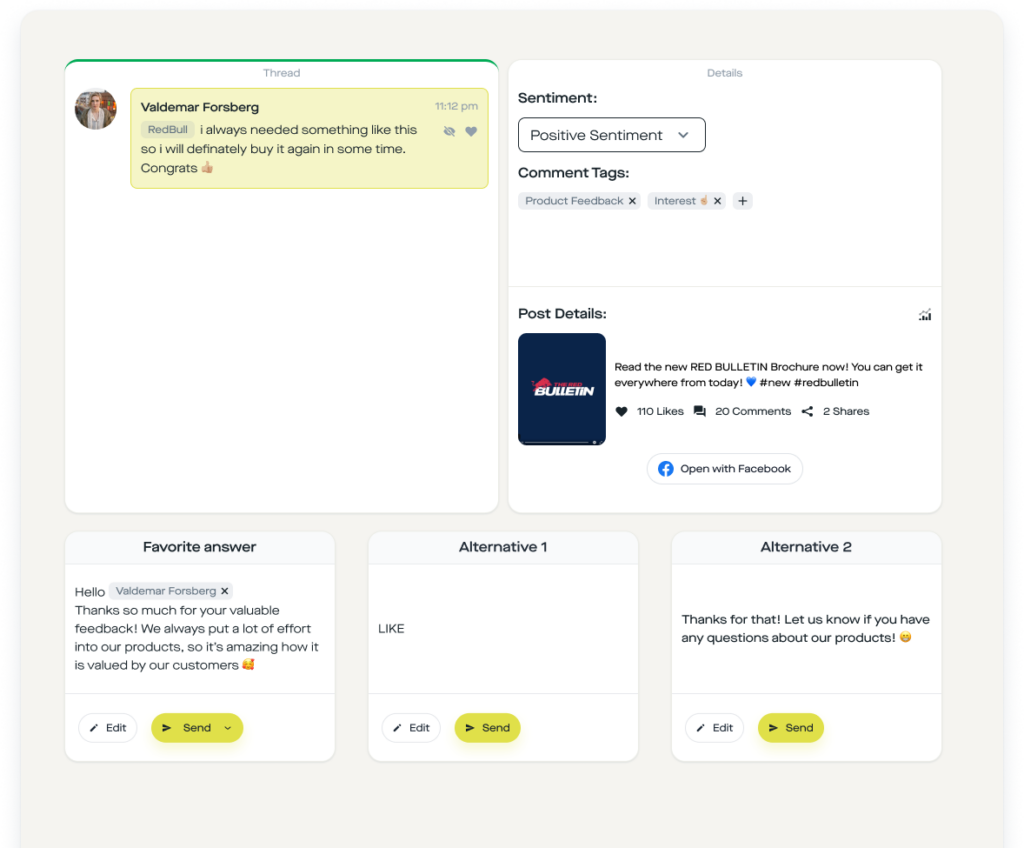
Real-time sentiment analysis: Each comment is automatically analyzed, is it spam, purchase intent, a valid complaint, or a troll? Custom tags enable individual categorization.
Auto-hide for spam and trolls: Harmful comments are hidden within seconds, not after hours or the next morning. With 400 spam comments per day, as with DJ Ötzi, manual moderation is simply impossible.
Notifications on escalation: Negative comments with high impact, for example a valid complaint on a high-budget ad, trigger an email or Slack notification. That way the right information reaches the right team member.
AI reply suggestions: Three suggestions per comment, based on your brand voice and past replies. "You might have canned responses, but then the same canned response appears under every comment. That feels robotic." AI suggestions sound like your team, not like a bot.
Automate comment moderation: Here's how it works
Frequently asked questions about negative comments on ads
Should you delete negative comments under Facebook Ads?
No, hide instead of delete. When you hide a comment, it stays visible to the author but becomes invisible to everyone else. That avoids the Streisand effect (public outrage over censorship). Hiding harmful comments can increase conversions by up to 34% (analysis of social ad campaigns, 2024). Only respond publicly to justified criticism, 80% of consumers trust brands more that respond to negative feedback.
Can you disable comments under Facebook Ads?
No, Facebook does not allow you to completely disable comments under ads. And even if it did, comments are an algorithmic engagement signal. Without comments the algorithm lacks a positive relevance signal, which can increase your CPMs. The better strategy is to actively manage comments instead of switching them off.
How quickly should you respond to negative comments under ads?
Within the first hour. 63% of consumers expect a response within an hour (Resolver Consumer Survey, 2024), but for ads speed matters even more. Most impressions occur in the first hours after launch. A negative comment left overnight will be seen by thousands of potential customers, without a response from your brand.
How do negative comments affect ROAS?
Massive impact. In a controlled A/B test the managed ad achieved about 50% better ROAS than the identical ad without comment management. Without a response CPM increases by 30 to 40% (analysis of social ad campaigns, 2024). Positive comments outperform negative ones in CTR with 97-98% statistical confidence (Social Media Lab A/B test, 2023).
When is automated comment management worthwhile for negative comments?
From 50 comments per day. Until then manual management is still feasible. From 200 comments you already spend 1.5 hours per day on manual clicking. At 300+ comments AI-powered automation becomes practically mandatory. SNOCKS processes over 300 comments per day in under an hour, which is equivalent to 0.5 saved full-time positions.
Further reading
- Social Media Comment Management: The Complete Guide 2026
- Optimize social proof on ads: How comments boost your ROAS
- The comment box is your sales pitch
- Why every unanswered comment costs you revenue
- Hiding comments: when and how
Your comment section needs a system, not guesswork
30% of your ad comments are negative. That is not an outlier, that is the average. The question is not whether negative comments will appear. The question is whether you have a system that distinguishes in real time: filter out spam, remove trolls, answer genuine criticism, convert purchase signals.
If you delete everything, you lose trust. If you ignore everything, you lose ROAS. If you apply the right framework, hide where necessary and respond where it matters, you protect your ad spend and build trust at the same time. This is not an either-or. This is a system.
Want to see how AI-powered comment management protects your ROAS? Start for free now, try it free for 14 days.


