Summarize this with
 ChatGPT
 Claude
 Gemini
 Perplexity
Every Android app collects reviews, and most developers read them without ever replying. Yet that reply is the cheapest lever you have on your Play Store rating. Google allows one public developer reply per review, and teams that use it strategically move their star average measurably upward. The problem isn't knowledge, it's scale: anyone answering reviews in five languages by hand in the Google Play Console every day, while squeezing each reply into 350 characters, eventually gives up. That's exactly where replient.ai comes in: respond to Google Play reviews with AI, trained on your own brand, from a single dashboard that bundles eight platforms.
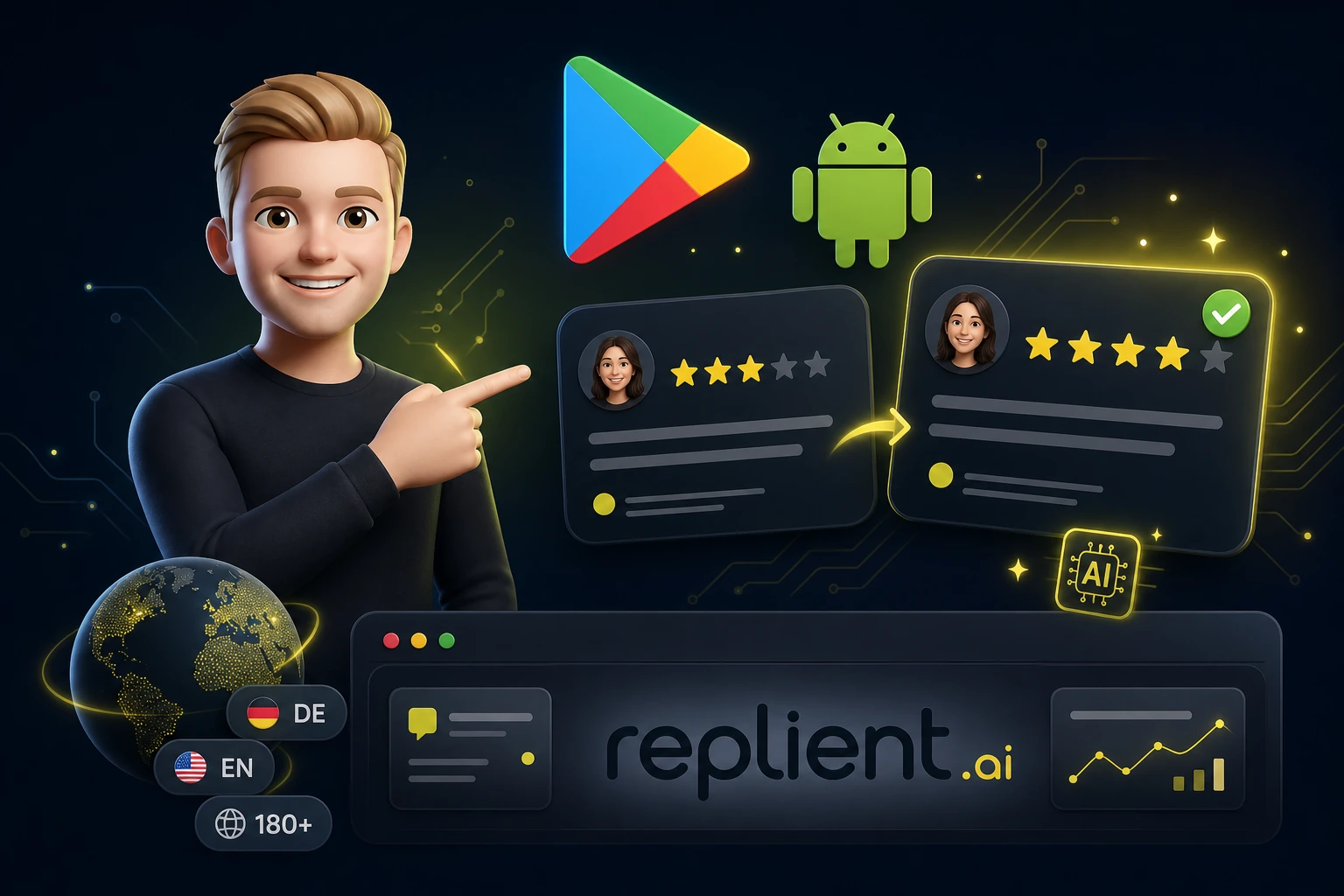
TL;DR: Replying to a negative Google Play review raises its rating by an average of +0.7 stars (Google Play Console, 2019). And because Google has given more recent reviews greater weight since 2021, every turned-around review counts for more than it used to. replient.ai connects your app through your Google account, pulls in new reviews automatically, and generates AI replies in your brand voice – editable, in all languages and dialects the AI understands, and correctly capped at 350 characters for Play.
Can you reply to reviews on Google Play?
Yes. Google offers the developer reply inside the Play Console: a public response that appears directly beneath the review and is visible to everyone. One clear rule applies – one reply per review. That reply is editable at any time: once you've fixed a bug, you overwrite your existing reply and reference the update.
The most important technical difference from Apple: on Google Play, developer replies are capped at 350 characters (Google for Developers). On the App Store you get up to 10,240. So on Android you have to be brief – every word counts. That's the first place the manual process breaks down for many teams: boiling a complex complaint down to three tight sentences takes time that no one has when 50 reviews land per day.
One more thing worth knowing: Google displays new reviews and your replies publicly with about a one-day delay. So you can react instantly, but the effect becomes visible with a lag. And one thing is impossible on either platform: you can't delete reviews. Neither you nor replient nor any other tool removes a negative review. The only legitimate way to neutralize a 1-star review is a good reply that convinces the user to update their rating.
Why does every reply lift your Play Store rating?
Because users change their rating when they feel heard. Google puts a number on the effect officially: a reply to a negative review raises its rating by an average of +0.7 stars, and apps that respond to reviews tend to have a higher overall rating (Google Play Console). That's not a soft marketing promise – it's a figure from Google's own developer backend.
On Android the lever works even harder than it used to. Since 2021, Google no longer shows the pure lifetime average but a rating that is weighted toward more recent reviews (Play Console Help; Android Developers Blog). A handful of fresh, turned-around reviews moves your visible average faster today than a mountain of old ones. Reply actively and you feed exactly that recent window.
And why bother at all? Because the rating decides downloads directly. Around 79% of users check reviews before installing an app (Apptentive consumer survey). The jump from three to four stars is the critical threshold.
So every answered review that jumps from one to four stars doesn't just push up your average – it also helps decide whether the next prospect even taps "Install."
How to respond to Google Play reviews with AI in replient.ai
The workflow is deliberately short: connect the app, train the AI on your brand, approve the replies. You connect your Android app through your Google account and enter your app's package name – the app ID in the format com.yourcompany.app. No separate file upload, no detour. A single connection covers multiple apps, as long as your Google account has access to them – ideal for cross-platform teams and agencies with an entire app portfolio. replient.ai pulls new reviews in automatically and files them in the feed with rating, text, and reviewer name. (Unlike Apple, Google Play has no title line for reviews – the review text is all you reply to.)
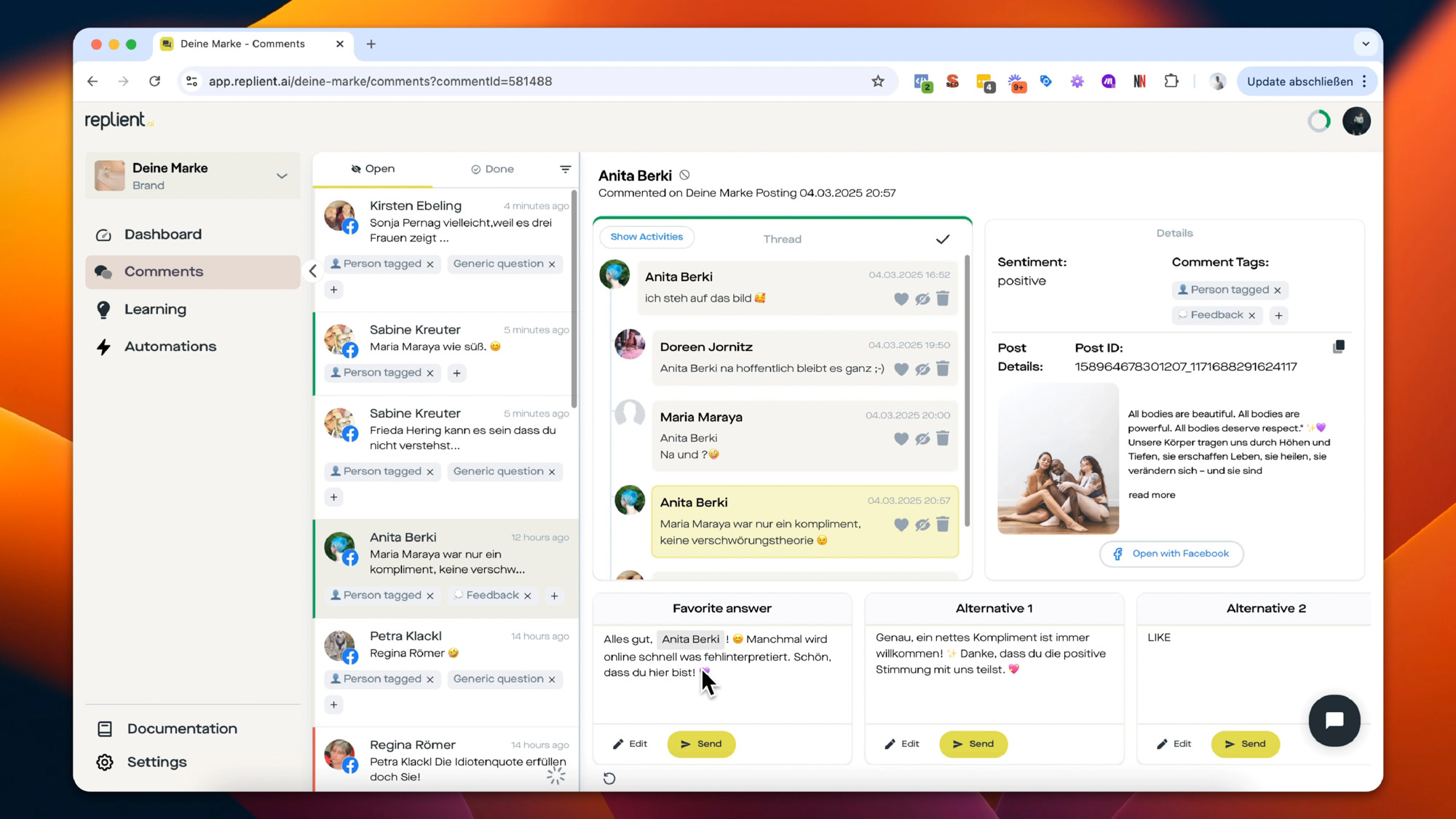
The core is the AI reply. For each review, the AI suggests several reply variants – if none fit, you regenerate, up to 15 times per review. What matters is what the AI is trained on: not generic marketing speak, but your website, uploaded documents (PDF, Word), and your past replies. That makes the suggestion sound like your support team typed it. And because Google caps replies at 350 characters, the AI automatically writes more concisely for Play and respects the limit – you never get a reply that gets cut off. You keep the final click: the AI suggests, you approve.
On top of that comes sentiment analysis: replient.ai detects the mood of each review and assigns tags that you define yourself. For Android teams these are often their own categories – you set up "Bug," "Crash," or "Feature request," for example, and the AI sorts new reviews into them automatically. Automation rules then let you filter specifically for low star counts (say, all 1- and 2-star reviews) and work through the critical cases first. At high volume you reach for bulk replies and send one AI reply to an entire group of similar reviews at once – something the Play Console doesn't offer natively, where every reply has to be typed individually.
How do you handle foreign-language Play reviews?
Globally available apps collect reviews in dozens of languages – and this is exactly where the manual process falls apart. The native machine translation in the Play Console only helps so much: it isn't verified and regularly misreads ambiguous words, so you end up having to interpret foreign-language reviews yourself anyway. replient.ai translates both incoming reviews and your replies, handling all languages and dialects the AI understands in the process. You read a Portuguese review in English, write your reply in English, and translate it back into Portuguese with one click.
How big this problem is in practice is clear from something we've seen in our own work. My brother Markus describes it from an onboarding call like this:
"We had a brand that had been holding steady in the DACH market and then said: let's add the Netherlands, let's add France. And suddenly you're getting 100 comments a day in French. That's when the real fun begins: you copy the comment, go into a translator, translate it into German, reply in German, and then translate it back into French. And the freelancer you hire has no idea what your product does. So it's almost impossible."
That triple hop – read, translate, write, translate back – is exactly what the built-in translation takes off your plate. For app publishers launching in several countries at once, it's often the difference between "we only answer German reviews" and "we answer all of them." That matters all the more since Google started showing users country-specific ratings in late 2021: a well-tended review channel now works per market, not just globally.
Google Play vs. App Store: what's different about replying
Both stores work the same way in principle – one developer reply per review, editable, publicly visible. The differences are in the details, and they matter when you run both platforms. replient.ai manages Google Play and the Apple App Store side by side in the same inbox, so you never have to switch between two backends.
| Feature | Google Play | Apple App Store |
|---|---|---|
| Replies per review | 1 (editable) | 1 (revisable) |
| Maximum reply length | 350 characters | 10,240 characters |
| Review title | ❌ review text only | ✅ title + text |
| Reply publication | immediate (public with ~1-day delay) | only after Apple approval |
| Connection in replient.ai | Google account + package name | Apple API key |
| AI reply & translation | ✅ All languages and dialects | ✅ All languages and dialects |
In practice this means: on Android you have to be brief, but your reply goes out without an approval step in between. The AI in replient.ai factors in these limits automatically and writes more concisely for Google Play. If you want to read up on the full two-store workflow, you'll find it in the post on how to automate app reviews – it also includes the ROI math for teams with three-digit review volumes. The iOS counterpart to this page covers the specifics of responding to App Store reviews with AI in detail.
Who benefits from AI-powered Google Play review management?
The break-even point is lower than most people think. Up to about 50 reviews a month, the Play Console is enough. From roughly 100 reviews a month – especially across several languages – the manual process tips over. The scale behind this: Google Play hosts over 2 million apps that together have collected more than 32 billion reviews (Statista). In that noise, response speed decides.
Three groups benefit most: Android publishers with a growing user base, cross-platform teams that don't want to manage iOS and Android twice over, and indie developers or agencies with several apps in their portfolio. For them, the auto-tagging feature is more than cosmetic: a large share of 1-star reviews on Android is about crashes and stability, as Google's own Android Vitals analyses show. Bundling those reviews automatically with your own "Crash" tag separates genuine product problems from feature requests – and routes them to the right team instead of letting them drown in the feed.
The decisive difference from pure app-store tools: replient.ai doesn't treat reviews in isolation. If you advertise an app, you often get the same complaints in parallel under Instagram or TikTok ads. That's why Google Play, the Apple App Store, and every social channel run through one dashboard in replient.ai. How much a well-tended comment and review channel affects revenue is shown by the Zauberfein case study, with +50% ROAS on social.
Frequently asked questions
Can I reply to a Google Play review more than once?
There is exactly one public developer reply per review, but it's editable at any time. You simply overwrite your existing reply with a new version – for example, once a reported bug has been fixed. In replient.ai you do this right in the feed, without opening the Play Console separately. The updated reply replaces the old one beneath the review.
How long can a reply to a Google Play review be?
Google caps developer replies at 350 characters (Google for Developers) – far fewer than the 10,240 characters on the App Store. replient.ai knows this limit and automatically writes AI replies more concisely for Play, so no reply gets cut off. You get a complete, precise answer instead of a truncated text.
Can I delete negative Google Play reviews?
No, neither you nor any tool can remove reviews. The only legitimate way is a good reply that convinces the user to update their rating. According to Google Play Console, a reply to a negative review raises its rating by an average of +0.7 stars – and since Google weights more recent reviews more heavily, every turned-around review affects your visible average especially fast.
How do I answer Play reviews in languages I don't speak?
replient.ai translates incoming reviews into your language and your replies back into the user's language – in all languages and dialects the AI understands. You read, write, and check in English, and it's published in the original language. That way you answer Japanese, Turkish, or Polish reviews just as consistently as English ones, without having to rely on the Play Console's native machine translation.
Does replient.ai manage the App Store and other platforms too?
Yes. replient.ai bundles eight platforms into one dashboard: Google Play, Apple App Store, Facebook, Instagram, TikTok, YouTube, LinkedIn, and Google Reviews. App reviews and social comments run through the same inbox – with unified brand-voice training, sentiment tagging, and translation.
Conclusion: short reply, big rating lever
Responding to Google Play reviews with AI isn't a gimmick – it's the cheapest way to actively steer your Android rating. Google gives you one reply per review with 350 characters – and that reply raises your rating by an average of +0.7 stars. Because Google weights more recent reviews more heavily, consistent replying pays off faster today than ever before. Anyone who wants to use this lever at 100, 300, or 500 reviews a month can't get around an AI-powered solution trained on their own brand.
The key points:
- +0.7 stars on average per answered negative review (Google Play Console)
- Google has weighted more recent reviews more heavily since 2021 – fresh replies work faster (Android Developers Blog)
- 4 stars is the threshold: 96% would consider a 4-star app, only 50% a 3-star one
- Play replies are capped at 350 characters – the AI automatically writes more concisely
- AI replies in all languages and dialects the AI understands, trained on your website, documents, and your history
Answer your Play Store reviews before your competitor does.
Try replient.ai free for 14 days and manage Google Play, the Apple App Store, and your social channels from one dashboard – with AI replies in your brand voice.
About the author

Co-Founder, replient.ai
Thomas is a co-founder of replient.ai and works on AI-assisted comment management for social media. He writes about automation, community management and efficient comment moderation for growing brands.