


I remember a moment when Markus, my brother and co-founder, was sitting on the toilet and, at the same time, hiding bullshit comments under our clients' ads. €20,000 ad spend a day, spread across six brands, comments every minute. "Three to five hours a day are spent just on comment management," he eventually said. And then it was clear: this can't continue.
The tipping point came sooner than expected. Our agency managed ten shops in parallel, just the two of us, with no team. We stopped on Friday night, checked back on Monday: the top-performing ad had a comment with 50 likes: "Don't buy this, it's fake!" ROAS plummeted. The whole weekend was ruined.
Social Media Comment Management: The Complete Guide 2026
TL;DR: At 20 to 30 seconds per comment, manual management becomes a full-time job at around 100 comments per day. 73% of customers buy from a competitor if brands do not reply (Sprout Social, 2025). The breakeven point between personnel costs and automation for most brands is between 50 and 150 comments per day. From that point, an AI tool not only saves time, it becomes cheaper than a part-time employee.
At what comment volume does manual management become impossible?
20 to 30 seconds per comment, that is the minimum, even with canned responses. At 100 comments a day that's 33 to 50 minutes of pure handling time. Sounds doable. But at 300 comments you're already at 2.5 hours. At 500 it's over four hours. And for the 3,000 comments one of our US healthcare clients gets daily, you'd need 15 virtual assistants working in parallel.
The problem is not just time. It's quality. Canned responses sound robotic, the same sentence under every comment. And the longer the response time, the less impact. Customers expect a reply within an hour, the average brand takes four to five hours (Sprout Social, 2025).
The three tipping points
Tipping point 1: 50 to 100 comments per day. One person can handle that on the side, just about. But quality and response time suffer. Early negative comments remain unanswered for hours.
Tipping point 2: 100 to 300 comments per day. It becomes a part-time job. You need either a dedicated person or a tool. Most brands are here when they run active ads.
Tipping point 3: 300+ comments/day. Impossible without automation. SNOCKS had 300+ comments daily and saved 0.5 full-time equivalents with AI automation. Health Routine reduced the workload by 90%. From here the math is clear.
Health Routine case study: 90% less effort in comment management
The real cost: What manual comment management actually costs you
A community manager in the DACH region costs between 35,000 and 45,000 euros gross per year, depending on experience and location. A part-time hire for 20 hours per week is about 1,500 to 2,000 euros per month. On top of that come payroll taxes, holiday entitlement, sick cover and onboarding.
The hidden costs nobody calculates
It is not just about the salary. It is about opportunity cost. Every hour your performance marketing team spends on comments is missing from creative testing, campaign optimization and strategy. We experienced this in our agency ourselves: "Time is better spent building new creatives than managing comments." Markus said this on the EcomSecrets Podcast, and he's right.
There is also the weekend factor. The team stops on Friday evening, on Monday morning there are 200 unanswered comments in the inbox. 73% of social media users will buy from a competitor if a brand does not reply (Sprout Social Index, 2025). What happens during the 60 hours no one is watching?
Why every unanswered comment costs you revenue
The ROI calculator: When does an AI tool pay off?
Let us run the numbers. A part-time hire (20h/week) costs all-in about 2,000 euros per month. At 25 seconds per comment they would theoretically handle 2,880 comments per week, if they did nothing else. In reality, with context switches, breaks and prioritization it is closer to 1,500.
An AI comment tool costs between 99 and 299 euros per month depending on volume. That is one tenth to one fifth of personnel costs. But the real ROI is elsewhere: the tool also replies at three in the morning on Saturday. It does not get sick. It does not forget a comment. And it learns from every reply.
Johannes from SNOCKS put it on LinkedIn like this: "We save half a full-time equivalent just with this tool." For a brand like SNOCKS with 300+ comments per day, that is a clear no-brainer.
The counter calculation for skeptics
"But we already have someone on the team doing that." True. But do the math: if that person needs two hours per day for comments, that is 44 hours per month with 22 workdays. At an all-in hourly rate of 25 euros that is 1,100 euros, just for comments. On top of that, that person could use the same time to build creatives, analyze A/B tests or optimize campaigns. Which has the higher ROI?
Setting up automatic replies: How to make the switch
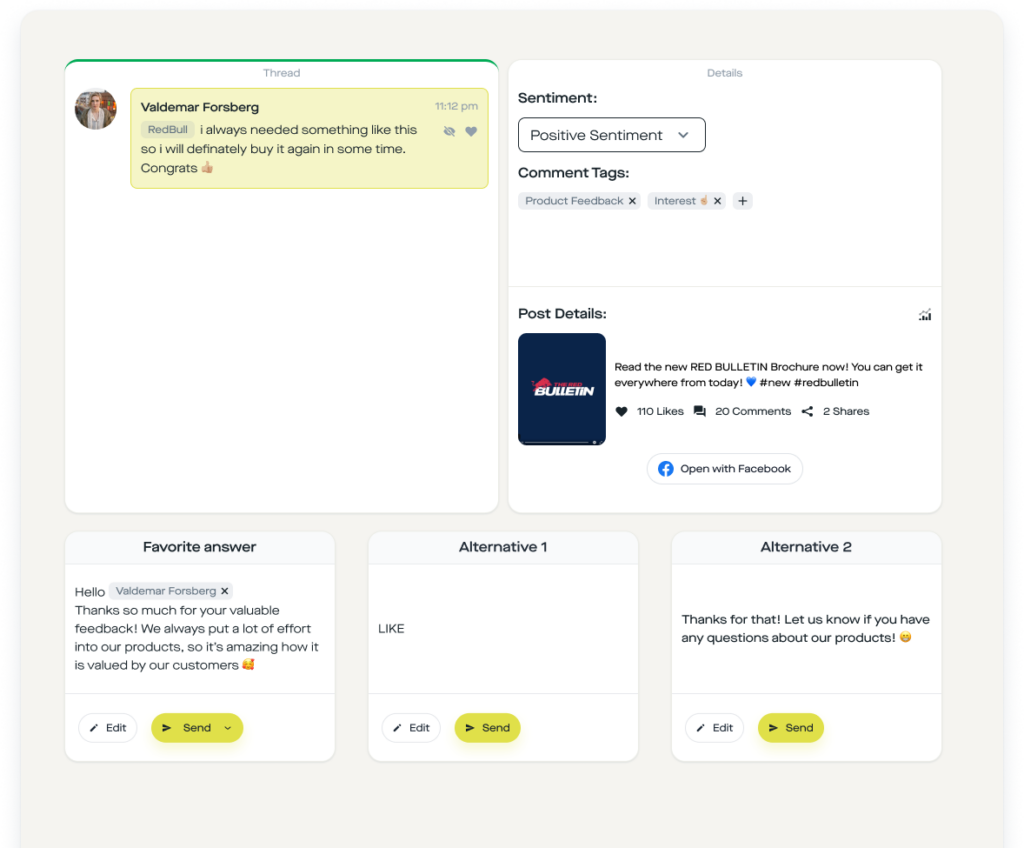
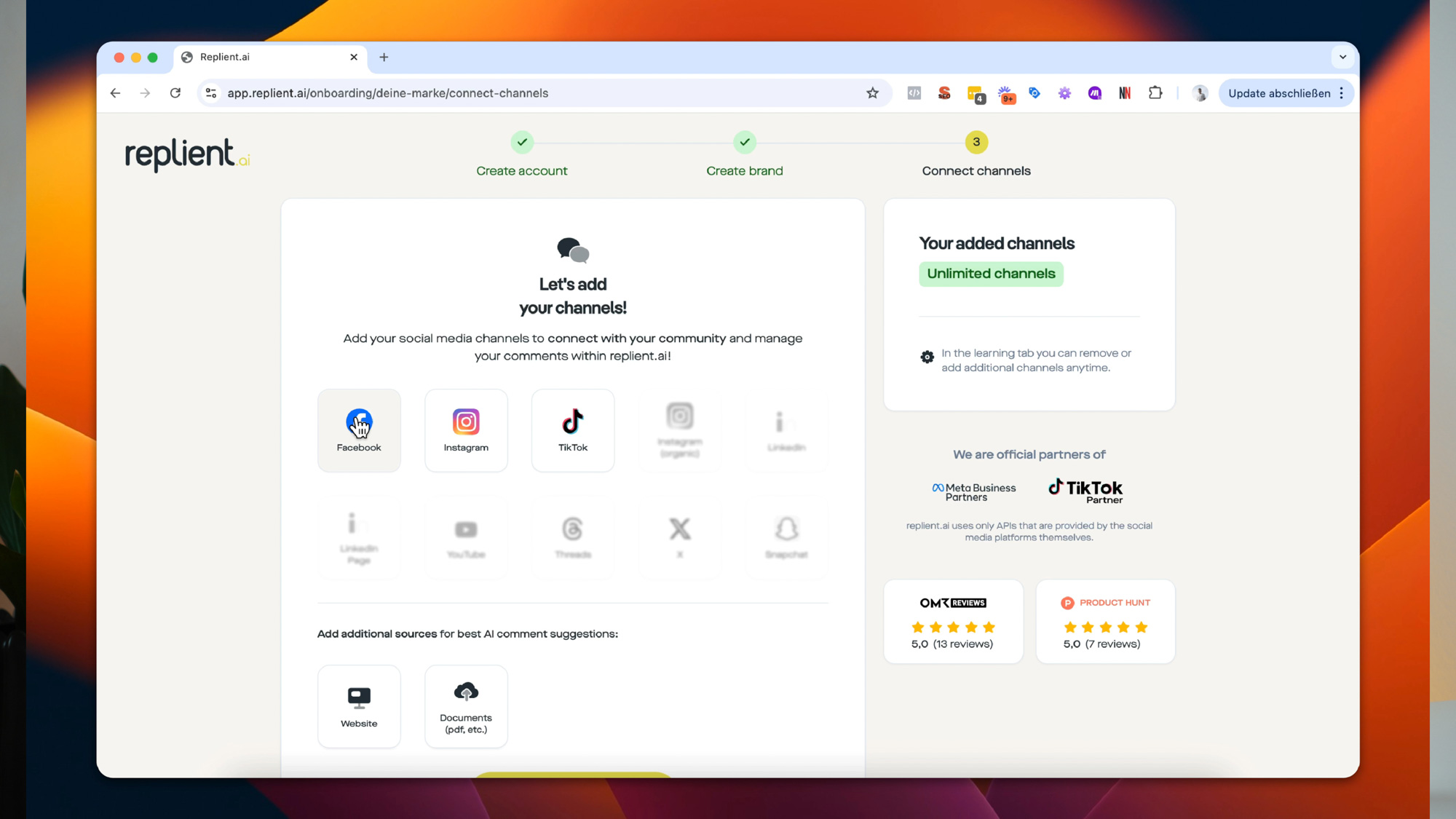
Switching from manual to automated is easier than most think. In our onboarding it looks like this: you connect your social media accounts, two or three clicks. The AI analyzes your historical comments and learns how you wrote in the past. Based on that, each new comment then receives three reply suggestions.

Stage 1: Semi-automatic. The AI suggests, you decide. One-click replies instead of 25 seconds typing. Most brands start here, maximum control, yet 80% time savings.
Stage 2: Rule-based automatic. You define if-then rules: spam is automatically hidden, purchase-intent comments get an immediate AI reply. Only escalations come to you.
Stage 3: Fully automated. Like with our US healthcare client. Every comment is answered automatically, with a random delay of one to ten minutes so it does not feel robotic. From 300 to 3,000 comments per day. Engagement exploded, reach increased, because the algorithm rewarded an active comments section.
Automate comment moderation: How AI moderation works in 2026

The special case: international brands
An underestimated tipping point: expansion into new markets. A DACH brand that expands into France and the Netherlands suddenly gets 100 comments in French. Copy the comment, put it in the translator, translate it into German, write the reply, switch back to French, that is almost impossible in day-to-day operations. With an AI tool you get reply suggestions directly in the respective language, you can check them in German and with one click translate them back.
AI comment replies vs Instagram bots: the key difference
FAQ: Comment automation for social media
Does replying to comments help the algorithm?
Yes. Meta and TikTok reward active comment sections with more reach. Every reply to a comment is an additional engagement signal. We have seen with customers that CPC drops and organic reach increases when comments are answered consistently. A US customer increased their comment volume from 300 to 3,000 per day, solely through automated follow-up questions.
Can you set up automatic replies on Instagram?
Yes, via the official Instagram Graph API and Meta Messenger API. AI-powered tools like replient.ai use these interfaces to generate reply suggestions. You can choose: semi-automatic (1-click replies), rule-based (If-Then automations) or fully automated. All variants run through the official API and do not violate the terms of use.
At how many comments per day does a tool pay off?
The breakeven point is, depending on personnel costs, between 50 and 150 comments per day. From 100 comments, manual management becomes a part-time job, over 30 minutes daily. From 300 comments, a tool is almost always more economical than an additional part-time employee, even without accounting for opportunity costs.
Will my followers notice that an AI is replying?
Not if the AI is properly trained. Unlike bots that use generic templates, an AI learns from your real historical replies, tone, word choice and brand voice. Each brand gets different suggestions, based on its own FAQs, product information and communication style. Most customers do not notice the difference.
How much does an AI comment tool cost compared to a part-time employee?
An AI comment tool costs between 99 and 299 euros per month, depending on comment volume. A part-time employee (20 hours/week) costs all-in about 2,000 euros per month. The AI tool is therefore up to 85% cheaper, and additionally replies around the clock, including weekends. SNOCKS thus saved 0.5 full-time positions, Health Routine reduced effort by 90%.
Want to know if automation is worth it for you? Start your free 14-day trial and test the difference yourself.
As of March 2026 | Author: Thomas Danninger, Co-Founder replient.ai


